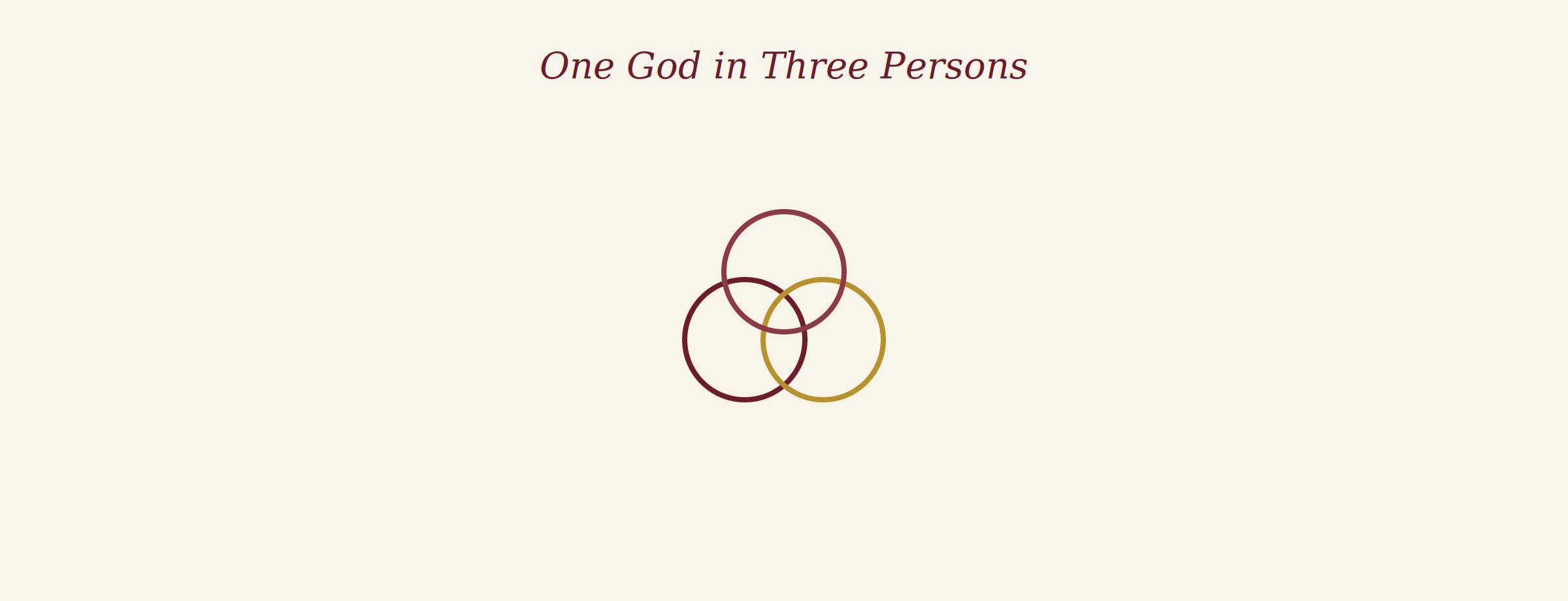
The Trinity is the Catholic teaching that there is one God who exists eternally as three distinct persons, the Father, the Son, and the Holy Spirit. Each person is fully God, not a third of God, and the three are not three separate gods but one single divine being. The Catechism calls this the central mystery of the Christian faith, the truth every other Catholic belief rests on (CCC 234).
That is a lot to hold in one sentence, and if it makes your head spin a little, you are in good company. Even the greatest theologians in Church history admitted this teaching is something God reveals rather than something the human mind arrives at on its own. What follows will not fully solve the mystery, because it cannot be solved. It can, however, be understood clearly enough to hold onto with confidence.

What Do Catholics Actually Mean by the Trinity
The Catechism states it with careful precision. We do not confess three Gods, but one God in three persons, the consubstantial Trinity. The divine persons do not share the one divinity among themselves but each of them is God whole and entire (CCC 253). At the same time, the three persons are genuinely distinct from one another. It is the Father who generates, the Son who is begotten, and the Holy Spirit who proceeds (CCC 254). The Father is not the Son. The Son is not the Spirit. Yet there are not three gods, only one.
This is not three names for one thing wearing different masks, an old error the Church calls modalism. It is not three separate beings working together, an error called tritheism. Catholic teaching holds both truths at once, three real persons, one undivided God, without collapsing either side to make the mystery easier.
Where Does This Teaching Come From
The word Trinity never appears in Scripture, but the pattern of Father, Son, and Spirit runs through it constantly. Jesus himself commands his apostles, Go, therefore, and make disciples of all nations, baptizing them in the name of the Father, and of the Son, and of the Holy Spirit (Matthew 28:19), naming all three as one name, singular, not three. Paul closes his second letter to the Corinthians with a blessing that names all three together as well: The grace of the Lord Jesus Christ and the love of God and the fellowship of the Holy Spirit be with all of you (2 Corinthians 13:14, NAB).
The Church’s precise language for this mystery developed over the fourth century, largely in response to a priest named Arius, who taught that Jesus was a created being rather than truly God. The Council of Nicaea in 325 responded by declaring the Son consubstantial with the Father, meaning of the same divine substance. The Council of Constantinople in 381 completed the picture by affirming the full divinity of the Holy Spirit as well. Both councils were not inventing a new belief. They were defending, in careful language, what the Church had already believed and worshiped from the beginning, against those trying to explain it away.

Getting to Know the Three Persons
| God the Father
The first person of the Trinity, whom Jesus taught his followers to call Abba, an intimate Aramaic word closer to Papa than the formal Father. He is the source without source, not caused by anything, the one from whom the Son is eternally begotten and from whom the Spirit eternally proceeds. |
 |
God the Son
The eternal Word, begotten of the Father before all ages, who became man in Jesus Christ without ceasing to be God. Everything the Father is, the Son is, except being Father. He is the visible image of the invisible God, as Paul writes to the Colossians (Colossians 1:15), the one through whom we come to know the Father at all. |
 |
God the Holy Spirit
The third person, who proceeds from the Father and the Son, described in Scripture as an advocate, a comforter, and the giver of life. He is the one Jesus promised would come after his ascension, to guide the Church into all truth (John 16:13), and the one Catholics believe still dwells within every baptized believer. |

Common Questions About the Trinity
Isn’t This Just Three Gods
No, and the Church has guarded this point carefully for two thousand years. There is one divine nature, one divine will, one God. The distinction is entirely in the relationships between the three persons, Father, Son, and Spirit, not in three separate centers of divinity. It helps to remember that person and nature are not the same thing. You have one human nature and are one person. God has one divine nature shared completely by three persons.
Can Any Analogy Actually Explain It
People have reached for water existing as ice, liquid, and steam, or a three leaf clover, the way Saint Patrick is said to have taught the Irish. Every one of these analogies breaks down quickly, because each describes one thing taking three forms in sequence, not three persons existing at once, eternally, in relationship. Saint Augustine is remembered in a well loved story, told for centuries though impossible to confirm with certainty, of encountering a child on a beach trying to pour the entire ocean into a small hole in the sand. When Augustine questioned him, the child answered that he had an easier task than Augustine did, trying to fit the mystery of the Trinity into his mind. The story endures because it names something true. This is a mystery to be received in worship, not a puzzle waiting for the right analogy to crack it open.
Why Does Any of This Matter for Ordinary Faith
Because it shapes everything Catholics believe about salvation itself. Catholics are not saved by a distant God observing from far away. The Father sends the Son, the Son gives his life, and the Spirit is poured out to dwell within believers. Salvation is, in a real sense, an invitation into the very life and love shared eternally between the three persons of the Trinity. This is why every Catholic prayer traditionally begins and ends in the name of the Father, and of the Son, and of the Holy Spirit, the same words spoken over you at your own baptism.

Living in Light of the Trinity
This teaching is not meant to stay in a theology book. A few simple ways it shapes daily Catholic life:
1. Make the Sign of the Cross slowly sometimes, rather than rushing through it, letting the words land as an actual naming of the God you are approaching.
2. Pray the Glory Be, which exists specifically to give praise to Father, Son, and Holy Spirit together, and notice how naturally the Church returns to this rhythm.
3. Remember your own baptism, when these same three names were spoken over you, and let that be the ground your faith stands on during harder seasons.
4. When prayer feels dry or confusing, rest in the fact that you do not need to fully understand the Trinity to be genuinely loved by all three persons of it.
| God did not reveal himself as Trinity to give us a riddle to solve. He revealed himself this way because it is who he actually is, community and communion at the very center of reality, and he made room in that love for you. |
The Heart of It
The Trinity is not a philosophical puzzle the Church invented to keep theologians busy. It is the Church’s honest attempt to name what God himself revealed about his own inner life, one God, three persons, united in a love so complete that Scripture simply says God is love (1 John 4:8). You do not need to solve that. You are invited to live inside it.
For more on the mysteries at the center of Catholic faith, visit Restored in Prayer, where the goal is always to help you know the God who first made himself known to us.
Glory be to the Father, and to the Son, and to the Holy Spirit.