A Plain Guide to What It Is, Where It Came From, and How to Read It
The Catechism of the Catholic Church is the official book that sets out what the Catholic Church believes, how she worships, how she asks her members to live, and how she prays. Pope John Paul II promulgated it on October 11, 1992, and it contains 2,865 numbered paragraphs in four parts. It is a reference book, and you can read it free online. Every part of it points to one person, Jesus Christ.
If you have ever asked a Catholic friend why the Church teaches something and got a shrug, the answer is probably written down in this book. It runs to hundreds of pages and can look like a wall the first time you open it. A map of a city shows where everything is and how the roads connect, and the Catechism does that for the whole of the faith. This guide explains what it is, how it came to be, how it is laid out, and how to start reading it without getting lost.

What Is the Catechism of the Catholic Church
The word catechism comes from a Greek word meaning to instruct by word of mouth. For two thousand years the Church has taught new believers the faith in plain, ordered lessons, and this book is the most complete of those lessons ever issued for the whole Church. In Fidei Depositum, the apostolic constitution that introduced it, John Paul II called it a sure norm for teaching the faith and a reference text for local catechisms. When he approved the final Latin edition in 1997, he described its purpose as a full, complete exposition of Catholic doctrine.
Everything in it comes from sources Catholics already trust: Scripture, the writings of the Church Fathers, the councils, the liturgy, and the lives of the saints. Almost every page carries footnotes that point back to them. Everything in it was received first, and the Catechism gathers it and sets it in order.
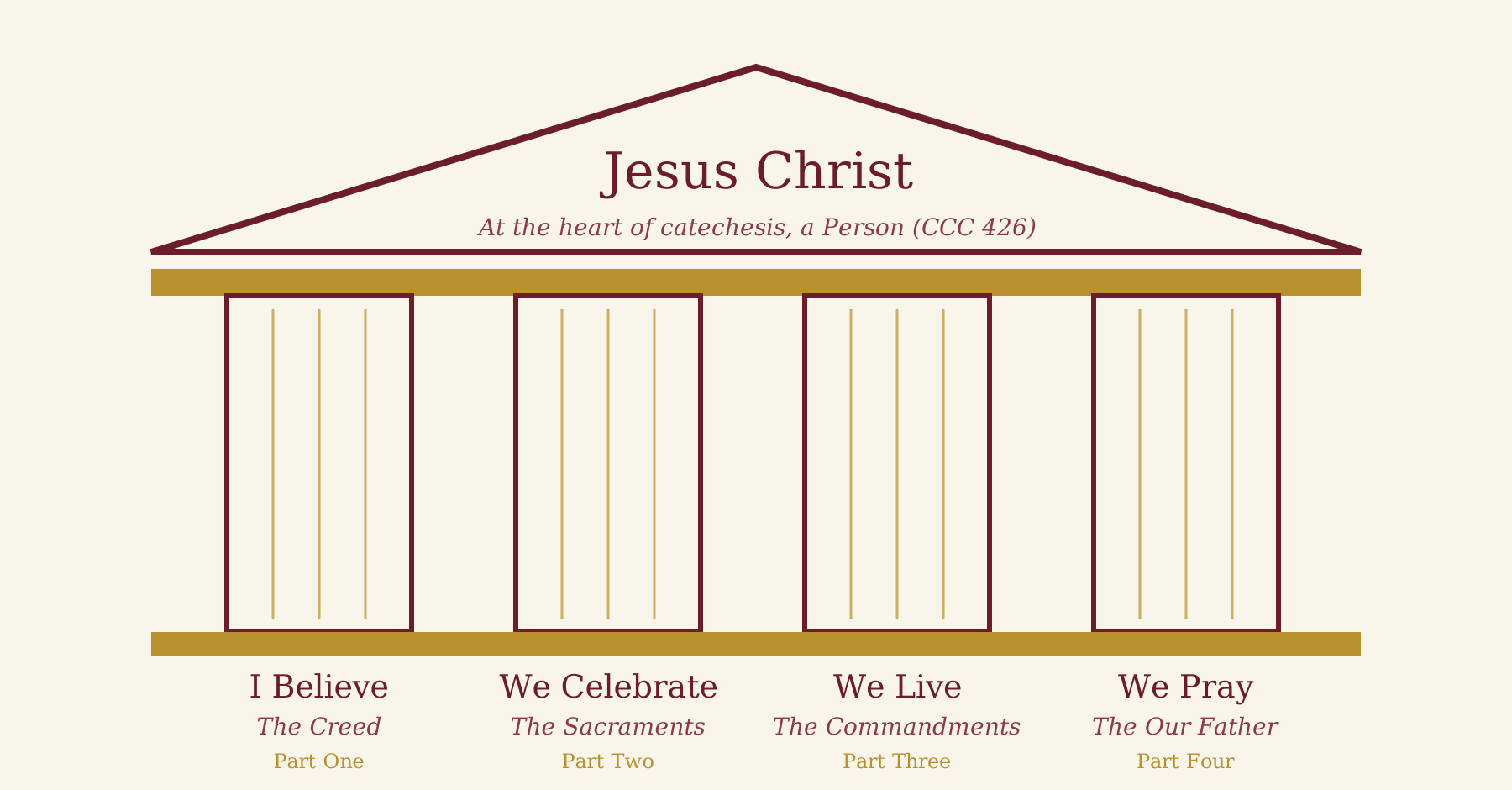
The heart of the book is a person. Paragraph 426 says that at the heart of catechesis we find, in essence, a Person, and it names him as Jesus of Nazareth (CCC 426). Every doctrine, every sacrament, every commandment is there because of him. Jesus is the one who teaches, who saves, and who gives the Church her voice, and the book is written to lead the reader to him.
Where Did the Catechism Come From
Catechisms are older than most people expect. Cyril of Jerusalem gave a famous series of lectures to new converts around the year 350, and he was already doing what this book does. After the Council of Trent, the Roman Catechism of 1566 gave priests a common guide, and in the United States the Baltimore Catechism, authorized by the bishops in the 1880s, was memorized by generations of Catholic children.
The modern Catechism began with a request. In 1985, twenty years after the close of the Second Vatican Council, the bishops at an Extraordinary Synod asked for a catechism for the whole Church. In 1986 John Paul II formed a commission of cardinals and bishops chaired by Cardinal Joseph Ratzinger, the future Pope Benedict XVI, to write it. Drafts went out to bishops around the world for comment. The USCCB’s page on the Catechism explains that the first version, written in French, was promulgated with Fidei Depositum in 1992, on the thirtieth anniversary of the opening of Vatican II.
The English translation came out in the United States in 1994. On August 15, 1997, John Paul II promulgated the official Latin text, the editio typica, with the apostolic letter Laetamur Magnopere, and the English second edition follows it. Ratzinger said years later that the project’s success still seemed like a miracle to him.
Two companions followed. In 2005 Pope Benedict XVI issued the Compendium, a short version in question and answer form. In 2011 came YOUCAT, a youth catechism written for teenagers and young adults.
How Is the Catechism Organized
The Catechism has a short Prologue, paragraphs 1 to 25, and then four main parts. They echo the life of the first Christian community in Jerusalem, who devoted themselves to the teaching of the apostles, to the breaking of the bread, and to the prayers (Acts 2:42). The Church believes, celebrates, lives, and prays, and each part takes one of those in turn.
| Part | Paragraphs | Theme | Built Around |
|---|---|---|---|
| One: The Profession of Faith | CCC 26 to 1065 | What Catholics believe | The Apostles’ Creed |
| Two: The Celebration of the Christian Mystery | CCC 1066 to 1690 | How Catholics worship | The Liturgy and the seven sacraments |
| Three: Life in Christ | CCC 1691 to 2557 | How Catholics live | The Beatitudes and the Ten Commandments |
| Four: Christian Prayer | CCC 2558 to 2865 | How Catholics pray | The Our Father |
 |
Part One: The Profession of FaithThis part walks through the Apostles’ Creed line by line. It covers God the Father and creation, Jesus Christ and what he did for us, the Holy Spirit and the Church, and the hope of resurrection and eternal life. If you want to know who Jesus is, Part One is where the Church lays it out. |
 |
Part Two: The Celebration of the Christian MysteryHere the Catechism explains the liturgy and the seven sacraments. It teaches that a sacrament is an efficacious sign of grace, instituted by Christ and entrusted to the Church (CCC 1131), and it takes Baptism, Confirmation, the Eucharist, Reconciliation, the Anointing of the Sick, Matrimony, and Holy Orders one at a time. |
 |
Part Three: Life in ChristThis part opens with a line from Pope Saint Leo the Great, Christian, recognize your dignity (CCC 1691). It covers the dignity of the human person, conscience, the virtues, grace, the Beatitudes, and the Ten Commandments, and it presents a moral life as the response of someone who has already been loved. |
 |
Part Four: Christian PrayerThe Catechism defines prayer as the raising of one’s mind and heart to God (CCC 2559). Part Four teaches how Christians have prayed through Scripture and the saints, and it ends with a long commentary on the Our Father. It also explains the Hail Mary (CCC 2676 to 2677) and the Rosary (CCC 2678), which pairs well with the full guide to praying the Rosary. |

How Do You Read the Catechism
You do not need to start at paragraph 1 and push through to 2865. Most readers do better with a plan.
1. Read the Prologue first. Paragraphs 1 to 25 explain why the book exists, and they are short.
2. Start with a question you actually have. Use the analytical index in the back to find the topic, then read the paragraphs it lists.
3. Follow the numbers in parentheses. They are cross references to related paragraphs, and one or two of them are usually worth a detour.
4. Read the large print first. The small print holds historical notes, examples, and quotations from the Fathers and saints. It deepens the large print and can wait until you want more.
5. Finish each section with In Brief. Each major section ends with a short summary of the key points in a few numbered statements.
6. Keep a Bible nearby. The footnotes cite Scripture constantly, and the Index of Citations at the back lists every passage the Catechism uses.
7. Go slowly. A few paragraphs a day is plenty. The podcast Catechism in a Year, hosted by Fr. Mike Schmitz, reads and explains it day by day if you want a companion.
The full text is free online at the Vatican’s website and through the USCCB, and most parishes keep print copies in the bookstore or the library.
Common Questions About the Catechism
Is the Catechism the same as the Bible
No. The Bible is the inspired word of God. The Catechism is the Church’s guide to understanding that word, and it quotes Scripture on nearly every page. Catholics receive Scripture and Tradition together as one deposit of faith, and the Catechism teaches both (CCC 80 to 82).
Can the Catechism change
The Church teaches that the deposit of faith itself does not change, and she also says that her understanding and expression of it can deepen over time. The Catechism has been edited. The 1997 Latin edition made adjustments to the first version, and in 2018 Pope Francis approved a new wording of paragraph 2267 on the death penalty. Many Catholics see revisions like these as the Church refining how she states what she holds, and the Catechism itself is the place to read exactly what the Church currently teaches.
Do I have to read the whole thing
No. It was written as a reference, and most people use it the way they would use a good atlas, looking up what they need. Reading all of it is a fine goal for a year, and starting with one question is a fine place to begin.
What is the difference between the Catechism, the Compendium, and YOUCAT
| Book | What It Is | Best For |
|---|---|---|
| Catechism of the Catholic Church | The full reference with 2,865 paragraphs | Study, teaching, and looking up a topic in depth |
| Compendium | A short question and answer version in the same four parts | Quick answers and review |
| YOUCAT | A youth catechism with a modern layout | Teenagers and young adults |

The Heart of It
Jesus is the one who makes people holy. He forgives, who feeds you in the Eucharist, and who teaches you to pray. The book gives you a clear, trustworthy picture of him and of the Church he founded, so that you can follow with open eyes. Jesus said that you will know the truth and the truth will make you free (John 8:32), and he said of himself that he is the truth (John 14:6). Open the book to a question you carry, and let it lead you to him.
For more guides to the Catholic faith, the sacraments, and prayer, visit Restored in Prayer, where every page is written to point you to Jesus.
Lord, to whom shall we go? You have the words of eternal life.