How to Check the Rules for Upcoming Solemnities
A holy day of obligation is a day other than Sunday when Catholics are asked to attend Mass and rest from unnecessary work. In the United States, the next three are the Immaculate Conception on Tuesday, December 8, 2026, Christmas on Friday, December 25, and Mary, Mother of God on Friday, January 1, 2027. Rules differ by country, so this guide also shows you how to check them for your own.
Every year someone stands in a parking lot on a weekday evening wondering whether today counts. The answer depends on the date, the day of the week, and where you live, and the rules have a few quirks that catch people out. This guide gives you the dates, the reasoning behind them, and a simple way to check any solemnity yourself. Behind every date is the same person. Jesus is the one waiting for you at the altar on these days, and the rules exist so that you do not miss him.
| A note on accuracy. The dates and norms below reflect the United States as of November 2026, drawn from the norms of the United States Conference of Catholic Bishops. Bishops’ conferences can change their lists, and dioceses sometimes add details, so confirm with your bishops’ conference or parish before you plan around a date. |

Which Holy Days of Obligation Are Coming Up
These are the days in the United States from now through the end of 2027, with the reason each one binds or does not.
| Date | Solemnity | Binding? | Why |
|---|---|---|---|
| Tuesday, December 8, 2026 | The Immaculate Conception | Yes | Patronal feast of the United States. It is a Tuesday, and it is not a Sunday of Advent, so nothing lifts or moves it. |
| Friday, December 25, 2026 | The Nativity of the Lord (Christmas) | Yes | Always binding. A vigil Mass on the evening of December 24 counts. |
| Friday, January 1, 2027 | Mary, Mother of God | Yes | It falls on a Friday, so the Saturday or Monday rule does not apply. |
| Thursday, May 6, 2027 | The Ascension of the Lord | Yes | Binding on Thursday only in provinces that keep the Thursday. Most move it to Sunday, May 9. |
| Sunday, August 15, 2027 | The Assumption of Mary | Yes | Sunday Mass already binds you, and this solemnity is celebrated at that Mass. |
| Monday, November 1, 2027 | All Saints | No | It falls on a Monday, so the obligation is lifted. |
| Wednesday, December 8, 2027 | The Immaculate Conception | Yes | A Wednesday, so it binds. |
| Saturday, December 25, 2027 | The Nativity of the Lord (Christmas) | Yes | Christmas binds on any day of the week. |
Two recent years show the rule at work. In 2026 the Assumption fell on a Saturday, so the obligation was lifted that August, and All Saints fell on a Sunday, which already binds. Diocesan calendars such as the Archdiocese of Saint Paul and Minneapolis and Catholic Answers’ list for 2027 set these dates out year by year.
Other upcoming solemnities that are not obligations
Several solemnities appear on the calendar without binding anyone to a separate Mass in the United States. They are still feasts of the highest rank, and many parishes celebrate them with extra care.
| Date | Solemnity | Notes |
|---|---|---|
| Sunday, November 22, 2026 | Our Lord Jesus Christ, King of the Universe | A Sunday, so your Sunday Mass is the celebration. |
| Sunday, January 3, 2027 | The Epiphany of the Lord | Celebrated on the Sunday between January 2 and 8 in the United States. |
| Friday, March 19, 2027 | Saint Joseph, Spouse of the Blessed Virgin Mary | Not an obligation in the United States. It falls in Lent. |
| Sunday, May 16, 2027 | Pentecost | A Sunday, so your Sunday Mass is the celebration. |
| Tuesday, June 29, 2027 | Saints Peter and Paul, Apostles | Not an obligation in the United States. |

What Is a Holy Day of Obligation
The Church’s first precept asks Catholics to attend Mass on Sundays and holy days of obligation and to rest from servile labor (CCC 2042). It grows out of the third commandment, Remember the sabbath day, to keep it holy (Exodus 20:8, RSV Catholic Edition). Canon law repeats it. The faithful are bound to participate in Mass on these days and, as far as possible, to refrain from work that gets in the way of worship, the joy of the Lord’s day, or proper rest of mind and body (canon 1247).
Jesus kept the feasts himself. Luke tells us his parents took him to Jerusalem every year for Passover (Luke 2:41), and John records him going up for other feasts (John 5:1 and John 7:10). The Letter to the Hebrews warns believers against neglecting to meet together (Hebrews 10:25). The Church’s holy days follow that pattern. They are set times when the whole community gathers to meet Jesus in the Eucharist.
The Catechism treats the obligation seriously. The faithful are obliged to take part in the Eucharist on days of obligation unless excused for a serious reason or dispensed by their pastor, and those who deliberately fail in this commit a grave sin (CCC 2181). That firmness is paired with mercy. Jesus gave his Church the power to forgive that sin (John 20:23), and Confession is always open.
How Did the List of Holy Days Get So Short
The early Church kept many feast days, and over the centuries the list grew long. In 1911 Pope Pius X trimmed it to ten in his reform Supremi disciplinae, as Wikipedia’s article on holy days of obligation and EWTN’s guide to the holy days describe. The 1983 Code of Canon Law keeps those ten (canon 1246), and it lets each bishops’ conference, with Rome’s approval, suppress some of them or move them to a Sunday.
The United States bishops used that authority. They settled on six, and in 1991 they added a rule that lifts the obligation for three of them when they fall on a Saturday or a Monday, since those days sit right beside a Sunday. The Holy See confirmed it in 1992. A later decision allowed each ecclesiastical province to decide whether the Ascension is celebrated on its Thursday or on the following Sunday.
| Universal Holy Day (Canon 1246) | Date | In the United States |
|---|---|---|
| The Nativity of the Lord (Christmas) | December 25 | Obligation, every year |
| The Epiphany of the Lord | January 6 | Celebrated on a Sunday, so no separate obligation |
| The Ascension of the Lord | 40 days after Easter | Obligation, on Thursday or the following Sunday depending on province |
| The Body and Blood of Christ | After Trinity Sunday | Celebrated on a Sunday, so no separate obligation |
| Mary, Mother of God | January 1 | Obligation, unless it falls on a Saturday or Monday |
| The Immaculate Conception | December 8 | Obligation, every year |
| The Assumption of Mary | August 15 | Obligation, unless it falls on a Saturday or Monday |
| Saint Joseph | March 19 | Not an obligation |
| Saints Peter and Paul | June 29 | Not an obligation |
| All Saints | November 1 | Obligation, unless it falls on a Saturday or Monday |

What Is a Solemnity and Why Do Some Begin the Evening Before
 |
The Highest Rank in the CalendarA solemnity is the highest rank of day in the Church’s calendar. The Church’s rules for the liturgical year say a solemnity begins with Evening Prayer on the preceding day, which is why the evening before is already part of the feast. The Gloria and the Creed are prayed at Mass on solemnities, and on a solemnity that falls on a Friday, the Church lifts the usual Friday abstinence from meat (canon 1251). |
That is also why a vigil Mass is more than a convenience. It belongs to the celebration. Canon 1248 says the obligation is satisfied by attending Mass on the feast day itself or on the evening of the preceding day, in any Catholic rite. Many parishes begin vigil Masses in the late afternoon.
Not every solemnity is a holy day of obligation. Saint Joseph, the Sacred Heart, the Annunciation, Saints Peter and Paul, and the Nativity of John the Baptist are all solemnities, and none of them binds anyone to a separate Mass in the United States. The word solemnity names the rank of the feast, and the obligation depends on your bishops.
How Do You Check the Rules for an Upcoming Solemnity
Here is a simple way to check any solemnity yourself, in the order that avoids mistakes.
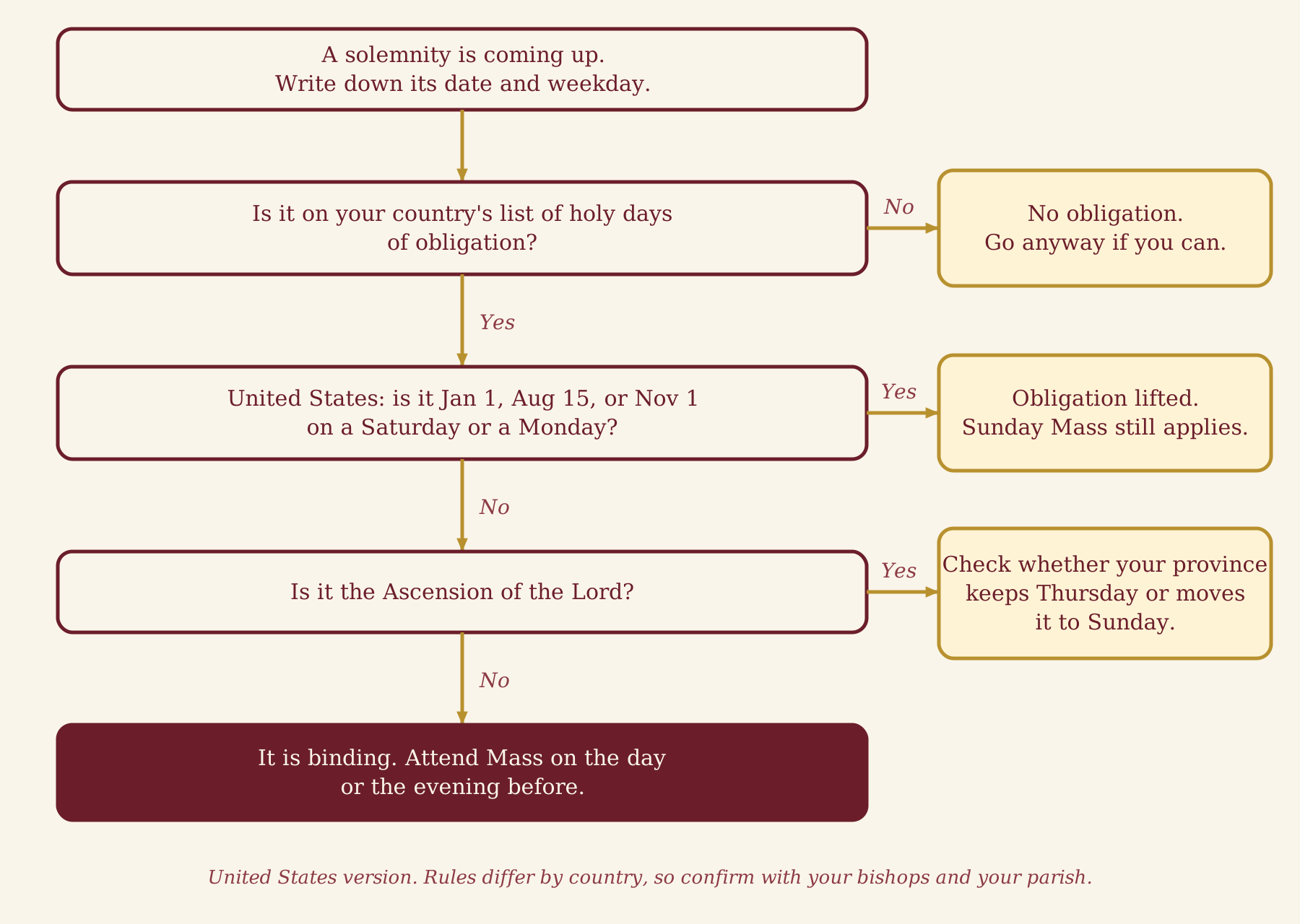
1. Write down the date and the weekday. Most surprises come from the weekday. A feast that binds in one year may not bind the next.
2. Find your bishops’ conference list. Canon 1246 lets each conference set its own days, so the list changes from country to country. In the United States the source is the USCCB. If you live elsewhere, look for your own national conference, for example the Kenya Conference of Catholic Bishops, and for your diocesan calendar.
3. Apply the weekday rule. In the United States, when January 1, August 15, or November 1 falls on a Saturday or a Monday, the obligation is lifted. It does not apply to Christmas or the Immaculate Conception.
4. Watch for transfers. When a solemnity is moved because a higher day takes its place, such as a Sunday of Advent or Lent, the date moves but the obligation does not move with it. A Sunday of Advent already binds you to Mass.
5. Check the Ascension. Ask your parish whether your province keeps the Thursday or has moved it to Sunday. A handful of provinces, among them Boston, Hartford, New York, Newark, Omaha, and Philadelphia, have kept the Thursday.
6. Look at the parish bulletin for Mass times. Parishes usually add extra Masses and a vigil Mass on holy days. Many are listed a week ahead.
7. Ask when you are still unsure. Your pastor knows the local norms and can dispense individuals for a good reason (canon 1245). If the day is not binding, you are still welcome. Jesus is there either way.
If you live outside the United States, the same steps work with your own list. The Kenya Conference of Catholic Bishops and your own diocese publish their norms, and a call to the parish office will settle the question quickly.

How Do You Fulfill the Obligation
 |
Go to MassTo fulfill the obligation, take part in Mass on the day itself or on the evening before, in any Catholic rite. Participation means being present at the celebration, listening to the readings, praying with the congregation, and, if you are properly disposed, receiving Communion. Watching a broadcast helps people who cannot be there, and it does not replace attending in person when you are able. Rest, too, is part of the day. Canon 1247 asks you, as far as you can, to set aside work that gets in the way of worship and relaxation. |
When Are You Excused From a Holy Day of Obligation
The Church knows that life is not always tidy. The Catechism names serious reasons as excuses, such as illness or the care of infants (CCC 2181), and your pastor can dispense you in a particular case. Common situations include:
- You are sick, contagious, or recovering and too weak to attend.
- You are caring for a baby, a sick person, or someone who cannot be left alone.
- Your work is unavoidable and essential, such as hospital, emergency, or public safety duties.
- You are traveling and cannot reach a Mass.
- No priest is available. The Church recommends in that case that the faithful take part in a Liturgy of the Word or spend time in prayer (CCC 2183).
None of these excuses requires permission when the reason is serious and real. If you are uncertain, speak to your priest. And if you have missed a binding holy day deliberately, go to Confession. Jesus is the one who forgives, and the confessional is where he says so out loud.
Common Questions About Holy Days of Obligation
Do children have to attend
The Church’s laws bind those who have reached the age of reason and completed seven years (canon 11). Parents are expected to bring younger children and to teach them why the day matters.
If Christmas falls on a Friday, do we abstain from meat
No. Canon 1251 lifts Friday abstinence when a solemnity falls on a Friday. That applies to Christmas Day this year, and again to Friday, January 1, 2027.
Does the vigil Mass on Christmas Eve count
Yes. Canon 1248 allows you to satisfy the obligation on the evening of the preceding day, and the same is true for every other holy day.
Are Ash Wednesday and Good Friday holy days of obligation
No. They are days of fasting and abstinence, and the Church treats them very seriously, but attendance at a service is not an obligation in the same way. Many Catholics attend anyway.
Why does the Saturday or Monday rule exist
The United States bishops lifted the obligation on a Saturday or Monday because those days sit next to a Sunday, and asking people to attend Mass on two days in a row was judged a burden. The rule applies only to January 1, August 15, and November 1. It never applies to Christmas or the Immaculate Conception.

How Can You Make a Holy Day Holy
1. Plan the evening before. Check the parish schedule early, and put the Mass time in your calendar. A vigil Mass is a fine option if the day is busy.
2. Go to Confession ahead of time. Many parishes add extra Confession times before major feasts.
3. Read the readings in advance. The day’s Scripture is available online and takes five minutes. It changes how you hear the Mass.
4. Bring your family. A holy day is a good way to teach children that Jesus is worth showing up for.
5. Add a small devotion. Pray a decade of the Rosary on a Marian feast, light a candle at home, or share a special meal.
| If a day does not bind you, go anyway when you can. The obligation sets the minimum, and love tends to want more. |
The Heart of It
A holy day of obligation can feel like a rule to keep track of, and it can also be an invitation. The Church sets these days apart because Jesus is present in the Eucharist, and on these days she asks everyone to gather around him at once. He gave himself at the Last Supper and he gives himself at every Mass. You do not earn that. You come, and he gives it. The psalmist captured the feeling when he spoke of his gladness at the invitation to go to the house of the Lord (Psalm 122:1).
For more guides to the Mass, the sacraments, and the feasts of the Church year, visit Restored in Prayer, where every page leads back to Jesus. You can also read the Catechism of the Catholic Church online for the Church’s full teaching on the Lord’s Day.
Let us go to the house of the Lord.