Twelve honest questions people ask about the Catholic faith, answered in order, with the Catechism, Scripture, and the objections fairly told.
Catholicism is the largest branch of Christianity, not a separate religion, and Catholics worship the Trinity and confess Jesus Christ as fully God and fully man. This guide explains what Catholics believe, what the Church asks of its members, whether the Bible uses the phrase Catholic Church, who Catholics pray to, the difference between worshipping God and honoring Mary, the five basic prayers, seven much loved prayers, and which country is closest to 100 percent Catholic. Key Scriptures: Matthew 16:18, John 1:1, John 20:28, 1 Timothy 2:5, Luke 1:28 to 48. Takeaway: the Catholic faith centers on Jesus, and the sharpest disagreements with Protestants are about how He gives Himself to His people, not whether He is God.
A quick word before we begin. I am a teacher who points to Jesus, not a priest, and not the final word on anything. Catholics, Protestants, and Orthodox Christians have disagreed for centuries, sometimes painfully. I have tried to state Catholic teaching the way the Church states it, quote its own documents, and then say plainly where other Christians push back. If you are Catholic, I hope you recognize your faith here. If you are not, I hope you feel respected and better informed. Either way, keep your eyes on Him. He is the one who saves.
The questions below are in the order I think makes most sense: first what Catholicism is, then what it believes about God, then how Catholics pray and live, then the prayers themselves, and finally the geography. You can jump to any section, but the early answers make the later ones easier to follow.
Is Catholic a religion or Christianity?
Short answer: Catholicism is Christianity. It is the largest branch of the Christian faith, and Catholics are Christians. The Catholic Church traces itself through the bishops back to the apostles, and it confesses the same Jesus Christ the New Testament proclaims. Calling Catholicism “a religion” is fine in everyday speech, since people also say “the Christian religion.” It becomes a mistake only if it suggests Catholics are outside the Christian faith.
Here is the numbers picture. According to the Pew Research Center, roughly half of the world’s Christians are Catholic, with the rest divided among Protestants, Orthodox, and other groups. The Vatican’s yearbook, the Annuario Pontificio, puts the worldwide Catholic population at about 1.4 billion. That is a very large share of everyone who has ever tried to follow Jesus.
Why does the question come up? Partly because Catholic life looks different from the inside of a Baptist or nondenominational church. There are statues, incense, a priest in vestments, a Mass with set words, and a Pope in Rome. Partly it is because some people grew up hearing “Catholics are not saved” or “Catholics are not real Christians.” Others heard the opposite, that Catholics are the only real Christians. Both statements are bigger than the evidence. The first Christians were one body in Jerusalem and Antioch. The splits came later: the East and West separated in 1054, and the Protestant Reformation began in 1517. Catholics, Orthodox, and Protestants all inherited the early Church, and each believes it keeps faith with it best.
The disciples were first called Christians at Antioch.
Acts 11:26 (WEB)
Notice the name. “Christian” means belonging to Christ, and it was given in Antioch, a city we will meet again in a moment because of a bishop who wrote the earliest surviving use of the word “catholic.” You can read that story in Acts 11.
Catholicism is not a rival to Christianity. It is the largest family inside it.
What about people who say Catholics are not saved? That is a theological argument about how salvation works, not a fact about whether Catholics are Christians. Catholics say Christ saves by grace through faith, working through love, and the Church lives that out in the sacraments. Many Protestants say salvation is by faith alone. Those are real differences, and we will name them honestly further down. But the great creeds, which declare Jesus fully God and fully man, are shared on both sides, and that matters more than most arguments online admit.
What is the Catholic religion, and what does being Catholic mean?
Being Catholic means belonging to the Church that Jesus founded on the apostles, believing what that Church teaches, and receiving Christ through its seven sacraments, above all the Eucharist. The Catholic religion is the faith, worship, and life of that Church, led by the Pope, who is the Bishop of Rome, together with the bishops. In Catholic belief, Jesus Christ is the one Savior, and the Church is His body, the place where He keeps meeting people with His word and His grace.
Where Catholics get their beliefs
Catholics hold that God has handed down His truth through three connected channels: Sacred Scripture, Sacred Tradition, and the Magisterium, which is the Church’s teaching office of the Pope and bishops. The Catechism says the task of interpreting the word of God authentically has been entrusted to the living teaching office of the Church. Protestants, by contrast, generally hold sola scriptura, that Scripture alone is the final authority. This is the root of most disagreements, and it is worth seeing early. When a Catholic quotes Church teaching and a Protestant asks “where is that in the Bible?”, they are often starting from different rulers. You can read the full Catechism of the Catholic Church on the Vatican’s own site, and the United States Conference of Catholic Bishops publishes accessible guides.
The seven sacraments
A sacrament, in the Catechism’s wording, is an outward sign instituted by Christ to give grace. Catholics count seven: Baptism, Confirmation, the Eucharist, Penance (also called Confession or Reconciliation), the Anointing of the Sick, Holy Orders, and Matrimony. A baby or an adult is baptized with water in the name of the Father, Son, and Holy Spirit. Confirmation seals the Spirit. At Mass, bread and wine become, Catholics believe, the Body and Blood of Christ. In Confession, a priest, acting in Christ’s name, pronounces forgiveness of sins. The Anointing of the Sick brings healing grace. Holy Orders ordains deacons, priests, and bishops. Marriage is a covenant of husband and wife blessed by God.
Jesus said to them, “Most certainly I tell you, unless you eat the flesh of the Son of Man and drink his blood, you have no life in yourselves.”
John 6:53 (WEB)
That verse, along with the Last Supper words “This is my body,” is why Catholics believe in the Real Presence, called transubstantiation in the Church’s technical language. It is also why Mass is not a memorial only. Many Protestants honor the Lord’s Supper deeply but understand the presence more symbolically or spiritually. Lutherans and Anglicans hold views that sit closer to the Catholic one. If you are not Catholic, you do not have to agree to understand why a Catholic kneels when the bread is lifted. They believe they are in front of Jesus.
The Pope, the bishops, and the saints
The Pope is the successor of Saint Peter and, in Catholic teaching, a visible sign of unity for the whole Church. Bishops are successors of the apostles. Priests serve under bishops and celebrate the sacraments. Saints are believers who have died and now live with God, honored as examples and asked to pray for us. Catholic life is also marked by a church calendar of Advent, Christmas, Lent, Easter, and Ordinary Time, which walks the whole story of Jesus every year.
Being Catholic means believing Jesus keeps meeting His people through the Church He gave them.
If you want one picture, imagine a family dinner at a very old table. Some of the faces have been there for two thousand years. That is how Catholics see the Church. A Protestant might say the table is real but the family also has other houses. An Orthodox Christian might say, “We never left that table either.” Everyone is looking at the same Host, though they argue over where the seat is set.
Does the Bible say “Catholic Church”?
No. The exact phrase “Catholic Church” does not appear in the Bible. The word “church” does, over a hundred times, and the idea of one universal body of believers is everywhere in the New Testament. The word “catholic” first appears in surviving Christian writing around the year 107, when Saint Ignatius of Antioch wrote to the church in Smyrna. Catholics argue that the thing the phrase names is thoroughly biblical. Many Protestants answer that the New Testament church and the later institution are not the same, and that tradition is not equal to Scripture.
WORD STUDY ἐκκλησία (ekklesia) called out assembly
The Greek word translated “church” in Matthew 16:18 is ekklesia. In the Greek world it meant a gathered assembly of citizens, from ek (out of) and kaleo (to call). In the Old Testament Greek it translated the Hebrew qahal, the assembly of Israel. Jesus says, “I will build my assembly.” Whatever else is argued, He claims the building is His.
WORD STUDY καθολικός (katholikos) according to the whole
The word is made of kata (according to) and holos (whole). It means universal or complete. Nobody in the New Testament uses it as a title. Ignatius uses it as a description: where Jesus is, there is the whole church. Later writers used it to distinguish the church spread through the world from local groups that had split away.
Here is what Ignatius wrote, in his letter to the Smyrnaeans: “Wherever the bishop appears, there let the people be, just as where Christ Jesus is, there is the catholic church.” The line is about Christ first and the church as the place where He is found. That wording is worth sitting with, because Catholics and Protestants both can hear it.
Matthew 16:18 and the rock
I also tell you that you are Peter, and on this rock I will build my assembly, and the gates of Hades will not prevail against it.
Matthew 16:18 (WEB)
This is the verse Catholics point to first. Jesus renames Simon as Peter. The Greek is Petros, and the word for rock is petra. Catholic teaching says Peter holds a unique role, symbolized by the “keys of the kingdom” in the next verse, an echo of the steward’s keys in Isaiah 22:22. Many Protestants answer that the rock is Peter’s confession (“You are the Christ, the Son of the living God”), or Christ Himself, because Paul says the rock in the wilderness was Christ in 1 Corinthians 10:4. Orthodox Christians typically say the rock is Peter and his confession, but do not read it as giving the bishop of Rome universal jurisdiction. You can read the whole scene in Matthew 16:13 to 20 and weigh it for yourself. Honest scholars on all sides admit the passage is richer than any slogan about it.
One more small note. In Acts 9:31, many ancient Greek manuscripts describe the church kath’ holes, throughout the whole of Judea, Galilee, and Samaria. It is the same root as katholikos. It is not the phrase “Catholic Church,” but it shows how naturally the idea of a church spread across places belonged to those first believers.
The words “Catholic Church” are not in the Bible, but the one body Christ is building certainly is.
Do Christians and Catholics worship the same God?
Yes. Catholics are Christians, and Catholics worship the one God, Father, Son, and Holy Spirit, the same God worshipped by Protestant and Orthodox Christians. The question is sometimes asked as if “Christians” meant only non Catholics. Properly, it asks: do Catholics and Protestants worship the same God? Both confess the Apostles’ Creed and the Nicene Creed. Both pray to the Father through Jesus Christ in the Holy Spirit. The differences are about authority, sacraments, Mary and the saints, and how salvation is received, not about who God is.
Hear, Israel: the LORD is our God. The LORD is one.
Deuteronomy 6:4 (WEB)
The Catholic Church’s teaching on this is spelled out in its documents. The Second Vatican Council’s Lumen Gentium and Nostra Aetate speak with respect toward Jews and Muslims and acknowledge what is true in other faiths, while insisting that Christ is the way. Catholic teaching toward other Christians is warmer still. The Church calls Protestants and Orthodox “separated brethren,” baptized and incorporated into Christ, though not in full communion.
In 1999 the Catholic Church and the Lutheran World Federation signed the Joint Declaration on the Doctrine of Justification, stating that on the central issue of the Reformation, how sinners are made right with God, they share a basic consensus. Not all Protestant churches agree with the declaration, and it did not end every dispute. But it shows that officially, at the highest levels, the two sides are not speaking about two gods.
Where do real differences remain? Protestants usually object to the authority of the Pope, the number of sacraments, prayer to Mary and the saints, purgatory, and the idea that grace comes through the sacraments rather than faith alone. Catholics usually object to what they see as a fragmented church without a clear teaching authority, and to dropping the sacraments Christ gave. These are serious disagreements. They are disagreements inside one family of believers who all call Jesus Lord.
PRAYER
Lord Jesus, You prayed that we would all be one. Heal the walls we have built between those who love You. Teach me to listen before I argue, and to love before I win. Keep my eyes on You, and let my words toward my Catholic and Protestant neighbors sound like Yours. Amen.
Do Catholics accept Jesus as God?
Yes, completely. Catholics believe Jesus Christ is the eternal Son of God, the second Person of the Trinity, fully God and fully man. The Catechism says the Church confesses that Jesus is inseparably true God and true man (CCC 464). The Catholic Mass is built around worship of Christ, and every Catholic creed says so. If you have heard that Catholics do not believe in Jesus, someone gave you wrong information.
In the beginning was the Word, and the Word was with God, and the Word was God.
John 1:1 (WEB)
Thomas answered him, “My Lord and my God!”
John 20:28 (WEB)
The Church’s belief is not an invention of later centuries. It rests on passages like John 1 and the story of Thomas in John 20, where the doubting disciple sees the risen Jesus and calls Him God, and Jesus does not correct him. Colossians 2:9 says all the fullness of deity lives in Him bodily.
The early councils defined it carefully. The Council of Nicaea in 325 confessed that the Son is “of one substance with the Father,” using the Greek word homoousios, in response to the teaching of Arius that the Son was a created being. You can read the history at Britannica on Nicaea. In 451 the Council of Chalcedon declared Jesus has two natures, divine and human, united in one person, without confusion or division (Britannica on Chalcedon). These are not just Catholic councils. Orthodox and most Protestant churches accept them. This is the shared floor that holds all three families together.
WORD STUDY ὁμοούσιος (homoousios) of the same substance
The word was the Council of Nicaea’s way of saying the Son is not like God or made by God, but is God, sharing the Father’s own being. It was debated fiercely. It carried the day because Scripture, worship, and the Church’s long memory already said it: Jesus is Lord.
Every Catholic Mass is, at its heart, an act of worship to Jesus Christ as God.
Who do Catholics pray to?
Catholics pray first and above all to God: the Father, the Son, and the Holy Spirit. Most Catholic prayers, including the Our Father and the Mass itself, are directed to God. Catholics also ask Mary, the angels, and the saints to pray for them, the way you might ask a friend to pray for you, except that Catholics believe those friends are alive in Christ in heaven. Catholics do not pray to the saints as if they were gods, and do not believe saints have any power of their own.
The Catechism says the saints “do not cease to intercede with the Father for us” (CCC 956), and describes prayer to them as asking for their intercession. Notice the verb. Catholics are asking them to pray, not to rescue. The principle is simple: if you can ask a living believer to pray for you, as James 5:16 invites, why would death cut off the family? Hebrews 12:1 speaks of being “surrounded by so great a cloud of witnesses,” which Catholics read as the saints in heaven.
Therefore let us also, seeing we are surrounded by so great a cloud of witnesses, lay aside every weight and the sin which so easily entangles us.
Hebrews 12:1 (WEB)
Protestants often raise an objection here, and it deserves a fair hearing. 1 Timothy 2:5 says there is “one mediator between God and men, a man, Christ Jesus.” The worry is that asking saints for help shares in Christ’s role. Catholics answer that Paul also asks others to pray for him, and that praying for one another does not replace Christ’s mediation. It flows from it. Many Protestants remain unconvinced, saying Scripture nowhere instructs believers to address the dead and that necromancy is condemned in Deuteronomy 18. Catholics reply that the saints are not dead but alive in Christ, as Jesus said in Luke 20:38. This is one of the deepest disagreements, and it is fine to say so plainly.
In practice, a Catholic’s prayer life usually includes the Sign of the Cross, the Our Father, the Hail Mary, the Rosary, and Mass. Many also pray to their patron saint, to Saint Joseph, to Saint Michael the Archangel for protection, and to their guardian angel. The USCCB prayer collection lists many of them with their texts.
When a Catholic asks a saint for prayer, the request is the same one you make when you text a friend, “will you pray for me?”
Do Catholics worship Mary?
No. Catholics honor Mary deeply but do not worship her. Worship, which the Church calls latria, belongs to God alone. Mary receives veneration, a special honor the Church calls hyperdulia, because she is the mother of Jesus and the first believer. The Catechism says the Church’s devotion to Mary is “intrinsic to Christian worship” (CCC 971), and also says it differs essentially from the adoration given to the Word incarnate and to the Father and the Holy Spirit. In the Catholic view, Mary is a creature, saved by her Son, and her whole role is to point to Him.
WORD STUDY λατρεία · δουλεία (latria and dulia) adoration and veneration
Catholic theology uses three Greek terms. Latria is adoration owed to God alone. Dulia is the honor given to saints. Hyperdulia is the higher honor given to Mary above all other saints. The distinction is not a modern invention. It was used by Thomas Aquinas and goes back to the early centuries. Whether it feels convincing or not, it shows Catholic teaching draws a clear line.
Why do Catholics honor Mary so much? Start with Scripture. The angel Gabriel greets her: “Rejoice, you highly favored one! The Lord is with you” (Luke 1:28). Elizabeth cries out, “Blessed are you among women, and blessed is the fruit of your womb” (Luke 1:42). Mary herself prophesies, “From now on, all generations will call me blessed” (Luke 1:48). Catholics take that last line seriously. The Council of Ephesus in 431 gave her the title Theotokos, God bearer or Mother of God, mainly to protect the truth about Jesus: the child she bore was truly God. You can read about it at Britannica on the Council of Ephesus.
From now on, all generations will call me blessed.
Luke 1:48 (WEB)
Catholics hold four Marian teachings: that she is the Mother of God, that she remained a virgin, that she was conceived without original sin (the Immaculate Conception, defined in 1854), and that she was taken up body and soul into heaven (the Assumption, defined in 1950). Protestants and Orthodox differ in different ways. Most Protestants reject the last two as unsupported by Scripture. The Orthodox accept her holiness and assumption but not the Immaculate Conception as Rome defines it. These disagreements are worth knowing, and a respectful conversation will say so.
The most telling Mary scene is at Cana. When the wine runs out, she says to the servants: “Whatever he tells you, do it” (John 2:5). It is the last recorded word of Mary in the Gospels, and it is a sentence that points away from herself. A fuller Catholic explanation is available in this Catholic explainer on Mary. Think about the Hail Mary: it is made from Scripture, from Gabriel’s and Elizabeth’s words, followed by a request, “pray for us sinners.” Catholics would say that is asking, not worshipping.
Mary’s last recorded words in the Gospels are “Whatever he tells you, do it.” She is always pointing to her Son.
Do some Catholics cross the line in practice? Honest priests admit that popular devotion can sometimes sound exaggerated, and the Church itself has warned against it. The Second Vatican Council’s Lumen Gentium chapter 8 cautions against false exaggeration and says Mary’s role does not take anything from the one mediator. Critics say that the language of some prayers and titles still gives the wrong impression. Catholics respond that the Church’s formal teaching is clear. Both sides can agree on one thing: Mary is not the Savior, and nobody in the Church says she is.
What are the rules for Catholics?
Catholics are asked to follow the Ten Commandments, the teachings of Jesus, and the Precepts of the Church, which are minimum expectations of a life of prayer and worship. The Catechism lists five precepts (CCC 2041 to 2043). The heart of all of them is love of God and neighbor, because Jesus said these two commandments sum up the whole Law. The rules are not a ladder to climb into God’s favor. In Catholic teaching they are the shape of a life already given by grace.
The five Precepts of the Church
First, attend Mass on Sundays and holy days of obligation, and rest from unnecessary work. Second, confess serious sins at least once a year. Third, receive Holy Communion at least during the Easter season. Fourth, observe the days of fasting and abstinence set by the Church. Fifth, provide for the needs of the Church according to one’s ability. These are summarized in the Catechism, which you can read at the Vatican’s Catechism page.
Fasting and abstinence
In the United States, Catholics from age 18 to 59 fast on Ash Wednesday and Good Friday, which usually means one full meal and two smaller ones with no snacking in between. Catholics age 14 and older abstain from meat on those two days and on the Fridays of Lent. Outside of Lent, bishops in the United States allow other penance on Fridays. The USCCB explains the details. Before receiving Communion, Catholics also fast from food and drink, except water and medicine, for one hour.
Holy days of obligation
Every Sunday is a day of obligation. In the United States other holy days include Mary, Mother of God (January 1), the Assumption (August 15), All Saints (November 1), the Immaculate Conception (December 8), and Christmas (December 25), with the Ascension observed on Thursday or Sunday depending on the diocese. The USCCB holy days page lists them and explains when the obligation is lifted.
Moral teaching and the works of mercy
Beyond the precepts, Catholic moral teaching covers marriage, life, justice, and honesty. The Church teaches that sex belongs to marriage between a man and a woman, that human life is sacred from conception to natural death, that the poor have a claim on our help, and that truth matters. It lists seven corporal works of mercy, such as feeding the hungry and visiting the sick, and seven spiritual ones, such as instructing the ignorant and forgiving injuries. Some of these teachings are widely admired and others are widely disputed, even among Catholics. A fair reader will see that the Church presents them as a way of life, not a list of arbitrary prohibitions.
You shall love the Lord your God with all your heart, with all your soul, and with all your mind. This is the first and great commandment. A second likewise is this: You shall love your neighbor as yourself.
Matthew 22:37 to 39 (WEB)
Are the rules a burden? Jesus Himself said, “My yoke is easy, and my burden is light” (Matthew 11:30). Catholics who live the faith often describe the rhythm of Mass, confession, and fasting as something that holds them up rather than weighs them down. Those who have drifted often describe the rules as the first thing they stopped feeling. Both experiences are real. The Church teaches that mortal sin can break communion with God, and that Confession restores it. You can only understand why Catholics go to confession if you see that they believe forgiveness is a real gift from Christ, given through the priest in His name, as in John 20:23.
Catholic rules are meant to be the shape of a life already given by grace, not a ladder to earn it.
What are the 5 basic Catholic prayers?
The five prayers most often taught first to Catholic children are the Sign of the Cross, the Our Father, the Hail Mary, the Glory Be, and the Apostles’ Creed. Some catechisms substitute the Act of Contrition or Grace Before Meals. Lists vary slightly, but these five are the usual foundation, and they appear at the start of every Rosary. Here is each one, in the traditional wording.
1. The Sign of the Cross
PRAYER
In the name of the Father, and of the Son, and of the Holy Spirit. Amen.
This is the smallest creed in the Church. It names the Trinity and traces the cross on the body. Catholics make it at the start and end of prayer, when passing a church, and before meals.
2. The Our Father (the Lord’s Prayer)
PRAYER
Our Father, who art in heaven, hallowed be thy name; thy kingdom come, thy will be done on earth as it is in heaven. Give us this day our daily bread, and forgive us our trespasses as we forgive those who trespass against us; and lead us not into temptation, but deliver us from evil. Amen.
Jesus gave this prayer to His disciples in Matthew 6:9 to 13 and Luke 11:2 to 4. The Catechism calls it “the summary of the whole gospel” (CCC 2761). At Mass, Catholics say it right before Communion. It is the one prayer every Christian shares.
3. The Hail Mary
PRAYER
Hail Mary, full of grace, the Lord is with thee; blessed art thou among women, and blessed is the fruit of thy womb, Jesus. Holy Mary, Mother of God, pray for us sinners, now and at the hour of our death. Amen.
The first half is Scripture, the angel’s greeting and Elizabeth’s blessing. The second half was added by the Church and asks Mary to pray for us. It is the prayer said most often in the Rosary.
4. The Glory Be
PRAYER
Glory be to the Father, and to the Son, and to the Holy Spirit, as it was in the beginning, is now, and ever shall be, world without end. Amen.
A short song of praise to the Trinity, used after each decade of the Rosary and at the end of the Psalms in the Liturgy of the Hours.
5. The Apostles’ Creed
PRAYER
I believe in God, the Father almighty, Creator of heaven and earth, and in Jesus Christ, his only Son, our Lord, who was conceived by the Holy Spirit, born of the Virgin Mary, suffered under Pontius Pilate, was crucified, died and was buried; he descended into hell; on the third day he rose again from the dead; he ascended into heaven, and is seated at the right hand of God the Father almighty; from there he will come to judge the living and the dead.
I believe in the Holy Spirit, the holy catholic Church, the communion of saints, the forgiveness of sins, the resurrection of the body, and life everlasting. Amen.
Protestants say this creed too. The phrase “holy catholic Church” in it means the universal church, not the Roman Catholic Church specifically, which is why many Protestant congregations recite it without any hesitation. That one line in a prayer shared by Catholics and Protestants alike tells you how much common ground there is.
If you only learn five prayers, learn the five that every Christian can say together, at least in part.
What are the 7 most powerful Catholic prayers?
No official list ranks Catholic prayers by power, and the Church teaches that the power of prayer is God’s, not the words’. That said, seven prayers appear again and again in Catholic homes: the Rosary, the Memorare, the Prayer to Saint Michael, the Divine Mercy Chaplet, the Anima Christi, the Come Holy Spirit prayer, and the Act of Contrition. People call them powerful because generations of Catholics have prayed them in hard times, and because each is drawn from Scripture or from the heart of the Church’s worship.
1. The Rosary
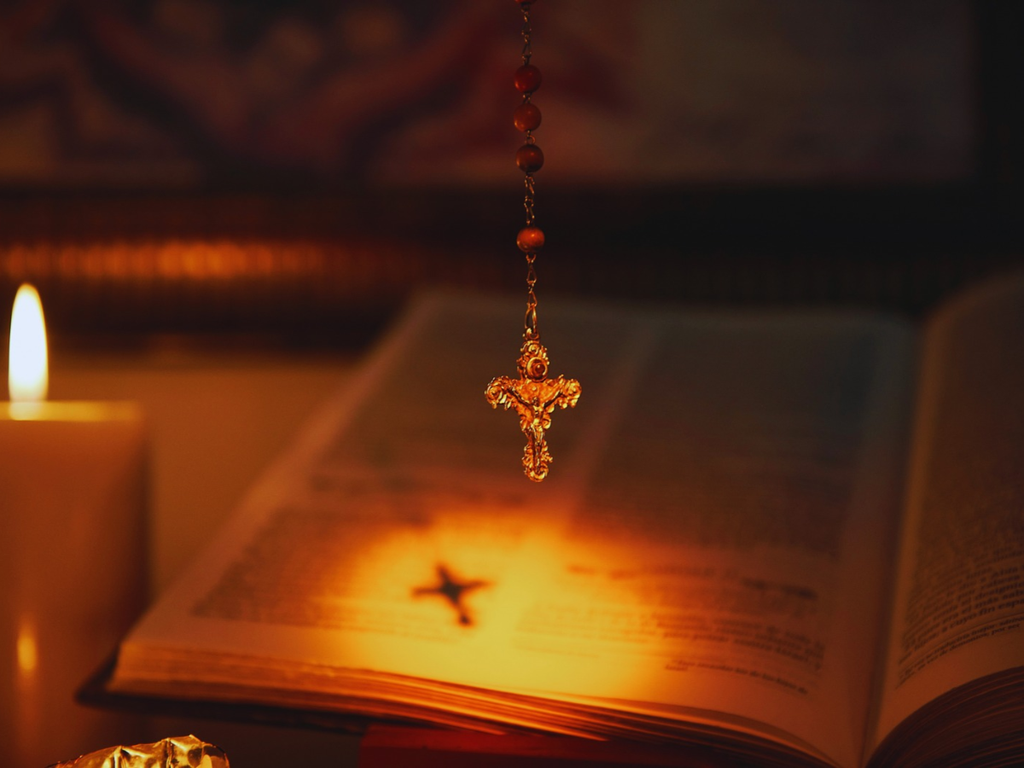
The Rosary is a prayer on beads in which Catholics repeat the Hail Mary while meditating on twenty events in the life of Jesus and Mary, called mysteries. Pope John Paul II called it his favorite prayer and described it as a school of contemplation of Christ. Its structure is the Apostles’ Creed, an Our Father, three Hail Marys, a Glory Be, and then five decades. The USCCB gives a step by step guide. Here is the thing many outsiders miss: the Rosary is a Christ centered prayer. The mysteries are about the Annunciation, the birth, the Passion, the Resurrection, and the Holy Spirit’s coming.
2. The Memorare
PRAYER
Remember, O most gracious Virgin Mary, that never was it known that anyone who fled to thy protection, implored thy help, or sought thy intercession was left unaided. Inspired by this confidence, I fly unto thee, O Virgin of virgins, my Mother; to thee do I come, before thee I stand, sorrowful and sinful. O Mother of the Word Incarnate, despise not my petitions, but in thy mercy hear and answer me. Amen.
3. The Prayer to Saint Michael the Archangel
PRAYER
Saint Michael the Archangel, defend us in battle. Be our protection against the wickedness and snares of the devil. May God rebuke him, we humbly pray; and do thou, O Prince of the heavenly host, by the power of God, cast into hell Satan and all evil spirits who prowl about the world seeking the ruin of souls. Amen.
Pope Leo XIII is traditionally credited with composing it in the 1880s. Many parishes say it after Mass. Notice that it asks God to rebuke the enemy and asks the angel to act only “by the power of God.”
4. The Divine Mercy Chaplet
Based on the visions of Saint Faustina Kowalska in Poland in the 1930s, the Chaplet is prayed on ordinary rosary beads, usually at three in the afternoon, the hour Catholics associate with Christ’s death. Its central prayer says: “Eternal Father, I offer You the Body and Blood, Soul and Divinity of Your dearly beloved Son, our Lord Jesus Christ, in atonement for our sins and those of the whole world.” Each decade continues, “For the sake of His sorrowful Passion, have mercy on us and on the whole world.” The Divine Mercy site explains how to pray it. It is a prayer entirely directed to the Father through the sacrifice of Jesus.
5. The Anima Christi
PRAYER
Soul of Christ, sanctify me. Body of Christ, save me. Blood of Christ, inebriate me. Water from the side of Christ, wash me. Passion of Christ, strengthen me. O good Jesus, hear me. Within thy wounds hide me. Suffer me not to be separated from thee. From the malicious enemy defend me. In the hour of my death call me, and bid me come to thee, that with thy saints I may praise thee forever and ever. Amen.
A prayer of the Middle Ages, loved by Saint Ignatius of Loyola, often said after Communion. Every line is addressed to Jesus.
6. Come, Holy Spirit
PRAYER
Come, Holy Spirit, fill the hearts of your faithful and kindle in them the fire of your love. Send forth your Spirit and they shall be created. And you shall renew the face of the earth.
This one is short and powerful in the plainest sense. It asks the Spirit to do what only the Spirit can do. Catholics use it before study, decisions, and meetings.
7. The Act of Contrition
PRAYER
O my God, I am heartily sorry for having offended Thee, and I detest all my sins because of Thy just punishments, but most of all because they offend Thee, my God, who art all good and deserving of all my love. I firmly resolve, with the help of Thy grace, to sin no more and to avoid the near occasions of sin. Amen.
Catholics pray this in Confession and at night. It is the prayer of a person who knows they need mercy and trusts Jesus to give it. In Catholic teaching, this is where freedom begins.
The power in any prayer is not in the wording. It is in the One who hears it, and He already loves you.
Which country is 100% Catholic?
Only Vatican City is effectively 100 percent Catholic, and it is a tiny city state with about five hundred residents. Among full sized nations, no country is 100 percent Catholic. The highest share belongs to East Timor, also called Timor Leste, in Southeast Asia, where about 97 percent of people identify as Catholic according to a 2024 report from Radio Veritas Asia. The same report notes that the Vatican, though 100 percent Catholic, is not a United Nations member state, so East Timor holds the highest percentage among UN members.
The story behind East Timor’s number is moving. Portuguese missionaries arrived in the sixteenth century, but the Catholic share jumped dramatically during the Indonesian occupation from 1975 to 1999. Indonesia’s official ideology required citizens to belong to a recognized religion, and Timorese traditional beliefs were not on the list. Many people turned to the Catholic Church, which also became a shelter and a voice for the people. Statistics vary by source and year, so treat any single percentage as an estimate.
Other countries with very high Catholic shares tend to be in Latin America and Europe: Paraguay, Colombia, Mexico, Poland, Malta, Italy, Portugal, and others, often in the range of 80 to 95 percent depending on the source. The largest Catholic populations by raw numbers are in Brazil, Mexico, the Philippines, the United States, and the Democratic Republic of the Congo. The figures change, so check the most recent data from the Vatican’s Annuario Pontificio or Pew before quoting a number.
Only one place on earth is completely Catholic, and it fits inside a few city blocks.
Frequently Asked Questions
Are Catholics saved?
Catholics believe salvation comes from Jesus Christ alone, by grace, received through faith and lived out in love, with the sacraments as the ordinary way grace is given. The Catechism says no one can earn salvation, and Catholics pray for it constantly. Many Protestants emphasize faith alone, and the two sides debate the details. But the 1999 Joint Declaration signed by the Catholic Church and the Lutheran World Federation affirmed a basic shared understanding that sinners are justified by God’s grace in Christ.
Can Catholics read the Bible?
Yes. Catholics are encouraged to read Scripture, and Mass includes readings from the Old Testament, Psalms, Epistles, and Gospel every day. The Catholic Bible has seven more books in the Old Testament than most Protestant Bibles, called the deuterocanonical books, including Tobit, Judith, Wisdom, Sirach, Baruch, and 1 and 2 Maccabees. Protestants regard them as useful but not inspired Scripture.
Why do Catholics confess to a priest?
Catholics base this on John 20:22 and 23, where the risen Jesus breathes on the apostles and says, “Whose sins you forgive, they are forgiven them.” Catholics see the priest acting in Christ’s name and by His authority. Protestants generally teach that believers confess directly to God and to one another. Both traditions agree that forgiveness comes from Jesus alone.
What is the difference between Catholic and Protestant?
The largest differences are authority (Scripture alone versus Scripture, Tradition, and the Magisterium), sacraments (two or three versus seven), the role of the Pope, prayer to Mary and the saints, and teaching about purgatory. Both share belief in the Trinity, the deity of Christ, the death and resurrection of Jesus, and the creeds.
Can I become Catholic?
Yes. Adults who want to join the Church go through the Rite of Christian Initiation of Adults, or RCIA, usually beginning in the fall and ending with baptism or reception at the Easter Vigil. Contact a nearby parish, and the USCCB has a guide to what to expect.
Sit With This Today
Where have I treated another believer as an opponent when Jesus calls them family?
What am I most afraid to ask about my own tradition, and what would it cost me to ask it honestly?
If someone watched my prayer life for a week, would they see me looking at Jesus?
Is there a Catholic, Protestant, or Orthodox friend I could listen to over coffee this month?
A Closing Prayer
PRAYER
Lord Jesus, You are the way, the truth, and the life, and no one comes to the Father except through You. I bring You my questions, my old arguments, and the places where I have judged others without knowing them. Thank You that You are God with us, that You died for me, and that You rose again. Teach me to read Your word with humility. Teach me to love those who worship You differently. Where I have been proud, forgive me. Where I have been afraid, steady me. Draw every one who calls on Your name into the unity You prayed for, and let the world see You in us. You are the one who saves, who sets free, who heals. I rest in You. Amen.
Continue Reading on Restored in Prayer
Explore more devotionals, Bible verse collections, and prayer guides at Restored in Prayer, including our articles on Catholic morning prayers, how to pray to God, Bible verses about prayer, and the complete Christian prayer guide.
Further reading from outside sources: the Catechism of the Catholic Church, the Pew Research Center on global Christianity, and the USCCB prayer collection.