A Step by Step Guide, From Examining Your Conscience to Hearing Go in Peace
To go to Confession, find your parish’s confession time, spend a few minutes examining your conscience, and walk in. Make the Sign of the Cross and say, Bless me, Father, for I have sinned. It has been [how long] since my last confession. Tell the priest your sins plainly, listen to his advice and your penance, pray an Act of Contrition, and receive absolution. A visit usually takes a few minutes, and it is Jesus who forgives you through the priest.
Maybe it has been a year. Maybe it has been thirty. Maybe you stood in line once as a child and never went back, or you are not sure how any of it works. Plenty of people stand at the door of the confessional with a pounding heart. Jesus told a story about a son who came home that way, and he said the father saw him while he was still far off and ran to meet him (Luke 15:20). That father is the one waiting for you. This guide walks you through every step, with the exact words, so that you walk in knowing what comes next.

What Is Confession and Why Do Catholics Go to a Priest
The sacrament has several names. The Catechism calls it the sacrament of Penance, of Reconciliation, of Confession, of Forgiveness, and of Conversion (CCC 1423 to 1424), and each name highlights something true. It is one of the two sacraments of healing, along with the Anointing of the Sick, and you can read how it fits among the seven in the Catechism of the Catholic Church.
Jesus did not leave forgiveness vague. When four friends lowered a paralyzed man through a roof, Jesus looked at him and said, Son, your sins are forgiven (Mark 2:5). On Easter evening he breathed on his apostles and told them, If you forgive the sins of any, they are forgiven (John 20:22 to 23, RSV Catholic Edition). Paul calls this the ministry of reconciliation that God has given to the Church (2 Corinthians 5:18).
The Catechism says plainly that only God forgives sins (CCC 1441). Jesus is the one who forgives, and he does it through the priest. When the priest celebrates the sacrament, he acts as the sign and the instrument of God’s merciful love for the sinner (CCC 1465). He is a servant of that forgiveness and never its owner (CCC 1466). You say your sins to a man, and you are really saying them to Jesus, who has already decided what he will do.
What Does Confession Actually Do for You
The Catechism lists the effects of the sacrament (CCC 1496), and a few of them are worth keeping in front of you. You are reconciled with God and with the Church. Grave sin, which cuts you off from God’s life, is forgiven. Peace and calm return to your conscience, and you receive spiritual strength for the next fight. As the Catechism puts it, the whole power of the sacrament is to restore you to God’s grace and to join you to him in an intimate friendship (CCC 1468). Many people describe it as setting down a bag they had carried so long they forgot it was heavy.
How Often Should You Go to Confession
The Church asks that anyone who has reached the age of discretion confess grave sins at least once a year (CCC 1457, canon 989). Anyone aware of a grave sin must confess before receiving Communion (CCC 1385). Children make their first Confession before their first Communion. The Catechism also recommends confessing venial sins regularly, because it helps you form your conscience, fight bad tendencies, and let Jesus heal you (CCC 1458). Many Catholics go once a month. Advent begins on Sunday, November 29, 2026, and many parishes add confession times throughout that season.

How Do You Prepare for Confession
 |
Pray, Then Examine Your ConscienceThe Catechism says to prepare by examining your conscience in the light of the Word of God (CCC 1454). Start with a short prayer, asking the Holy Spirit to show you your life honestly. Then look back over the time since your last confession, using the Ten Commandments or the Beatitudes (Exodus 20:2 to 17; Matthew 5:3 to 10) as a guide. Write down what you find if that helps. |
| A Simple Prayer Before Confession
Pray this in the pew or in the car. Holy Spirit, help me to see my life the way Jesus sees it. Show me what I need to confess, give me the courage to say it, and let me trust that he is waiting for me with open arms. Amen. |
Here are questions to ask yourself, grouped by the Ten Commandments as the Catechism numbers them. You do not have to answer every one. The point is to notice what is true.
| Commandment | Questions to Ask Yourself |
|---|---|
| 1. I am the Lord your God | Have I put anything ahead of God, such as money, work, or a relationship? Do I pray? Have I turned to horoscopes, fortune tellers, or the occult? Have I let my faith go cold on purpose? |
| 2. Do not take the Lord’s name in vain | Have I used God’s name carelessly or cursed? Have I sworn falsely? Have I spoken with contempt about holy things? |
| 3. Keep holy the Lord’s day | Have I missed Sunday Mass or a holy day of obligation without a serious reason? Have I treated Sunday as just another workday? |
| 4. Honor your father and mother | Have I been disrespectful, impatient, or neglectful toward my parents, spouse, or children? Have I failed in my duties at home? |
| 5. You shall not kill | Have I held onto anger, hatred, or revenge? Have I harmed anyone in body or spirit? Have I abused alcohol or drugs, or neglected my health? Have I taken part in or encouraged abortion or euthanasia? |
| 6. You shall not commit adultery | Have I been faithful to my spouse in thought and action? Have I failed in purity through what I looked at, thought about, or did? |
| 7. You shall not steal | Have I taken or kept what is not mine, cheated, or failed to pay what I owe? Have I been generous with the poor? |
| 8. You shall not bear false witness | Have I lied, gossiped, or damaged someone’s good name? Have I broken a confidence? |
| 9. You shall not covet your neighbor’s wife | Have I let lust or jealousy toward another person take root in my thoughts? |
| 10. You shall not covet your neighbor’s goods | Have I envied others, been greedy, or been ungrateful for what I have? |
Do not forget sins of omission, the good you failed to do. Jesus told a parable about people who never fed the hungry or visited the sick and were judged for it (Matthew 25:41 to 46).
How do you tell a mortal sin from a venial sin
The Catechism says a sin is mortal when three conditions are all present: grave matter, full knowledge, and deliberate consent (CCC 1857). A venial sin weakens love without breaking it (CCC 1862). You do not need to settle every case on your own. If you are unsure, tell the priest what happened and ask him to help. That is what he is there for.
A word to anyone who tends to worry. The examination is meant to be honest and short, and it should leave you free. If you find yourself replaying every thought and never feeling forgiven, tell your confessor. A good priest knows that scrupulosity is a real burden, and he can help you carry it.

What Do You Say and Do in the Confessional
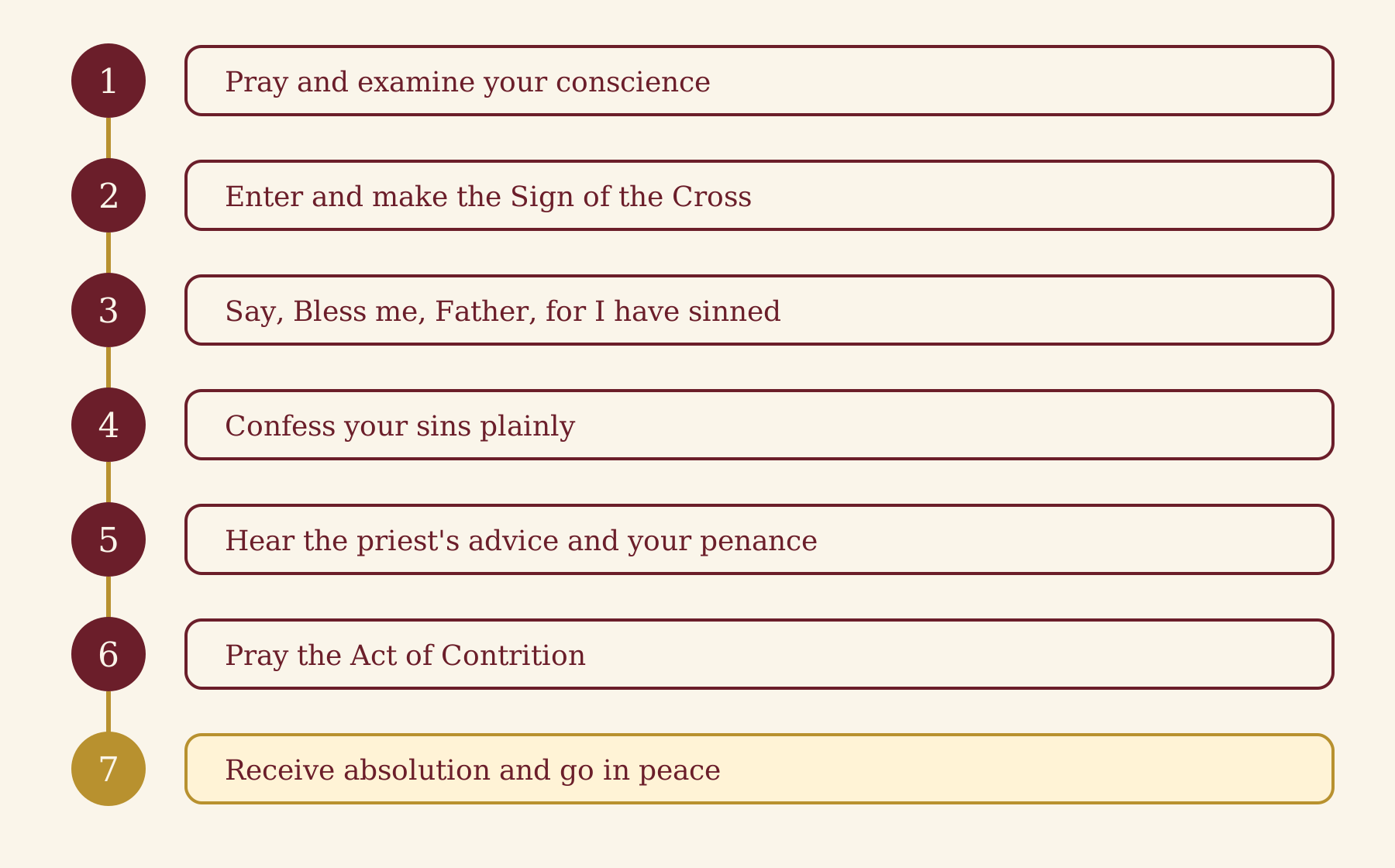
Here is the whole sequence at a glance, followed by the exact words.
 |
Entering the ConfessionalMany churches offer both a screened confessional and a room where you sit face to face with the priest, and you may choose whichever helps you pray. The priest may say a greeting, or he may say nothing at the start. Some priests read a short passage of Scripture. Either way, you begin with the Sign of the Cross. |
| Your Opening Words
Say these as you begin. In the name of the Father, and of the Son, and of the Holy Spirit. Amen. Bless me, Father, for I have sinned. It has been [how long] since my last confession. (If it is your first time, say so: Bless me, Father, for I have sinned. This is my first confession.) The wording is traditional and a few small variations are fine. What matters is that you tell the priest how long it has been. |
1. Pray and examine your conscience. Do this before you go, using the questions above.
2. Enter and make the Sign of the Cross. Say the words aloud with the priest.
3. Say, Bless me, Father, for I have sinned. Then tell him how long it has been since your last confession. If you cannot remember, a rough guess is fine.
4. Confess your sins. Say them plainly and in your own words. For grave sins, the Church asks you to name the kind and, as best you can, the number of times (CCC 1456). Skip the long story and the excuses. If you are unsure what to say or feel uneasy, tell him and ask for help. When you finish, you can say something like, For these and all my sins, I am sorry.
5. Listen to the priest. He may offer advice or encouragement. He will then give you a penance, which he introduces with the words, For your penance.
6. Pray the Act of Contrition out loud when he asks you to. The full traditional text is below.
7. Receive absolution and go in peace. The priest extends his hand over you and prays that God will give you pardon and peace through the ministry of the Church. Then he says, I absolve you from your sins, and he names the Father, the Son, and the Holy Spirit (CCC 1449). Answer, Amen. He will dismiss you with words such as, The Lord has freed you from your sins. Go in peace, and you answer, Thanks be to God.
After you leave, do your penance as soon as you can, ideally that same day.
| The Act of Contrition
Pray this after the priest gives you your penance. O my God, I am heartily sorry for having offended Thee, and I detest all my sins because of Thy just punishments, but most of all because they offend Thee, my God, Who art all good and deserving of all my love. I firmly resolve, with the help of Thy grace, to sin no more and to avoid the near occasions of sin. Amen. Many people keep a copy on a card or on their phone, and most confessionals have one posted. You may also use shorter forms, such as the prayer from the Rite of Penance, Lord Jesus, Son of God, have mercy on me, a sinner. The United States bishops provide several versions at usccb.org/confession. |
The USCCB’s step by step guide and its bulletin insert on Penance lay the same sequence out in print form, and many parishes keep them near the confessional.
What Is Contrition and Do You Have to Feel Sorry Enough
 |
Sorrow Is a Decision, and Also a GiftContrition means sorrow for your sin joined to a decision not to sin again (CCC 1451). The Catechism describes perfect contrition, which comes from love of God, and imperfect contrition, which comes from seeing how ugly sin is or from fear of its consequences (CCC 1452 to 1453). Imperfect contrition is a gift of the Holy Spirit too, and it is enough for the sacrament. You do not need to feel a certain emotion. You need to want to turn back, and Jesus supplies the rest. |
What Is a Penance and What Do You Do After Confession
Absolution takes away your sin, and sin also leaves damage behind, in your habits, your relationships, and your soul. The penance is a small step toward repairing it (CCC 1459 to 1460). It might be a prayer, an offering, a work of mercy, or an act of service. Do it soon, while the moment is fresh.
Then say thank you. Stay a few minutes in the church. You have just been forgiven by the Son of God, which deserves a moment. Remember the resolution you made in the Act of Contrition, to sin no more and to avoid whatever leads you to sin. When you fall again, and most of us do, come back. Peter once asked Jesus how many times he should forgive, and Jesus answered, seventy times seven (Matthew 18:22). Jesus gives that same mercy to you.

Common Questions About Confession
What if I am nervous or do not know what to say
Tell the priest. Say that it is your first time, or that it has been a long time, or that you are nervous. He will guide you through every step. Priests are trained to receive confessions with mercy (CCC 1465 to 1466), and a priest is usually glad to see someone return.
What if it has been many years
The steps are the same. You do not need to list every sin of every year. Confess the grave sins you remember, naming the kind and a rough number, and tell the priest about the long gap. The father in Jesus’ story did not ask his son to account for every day he was gone.
What if I forget a sin
If you honestly forget a sin after a sincere examination, it is forgiven along with the rest, and you can mention it the next time you go. Do not carry it around as a worry.
Can the priest tell anyone what I say
No. The seal of confession is absolute. The Church forbids a priest to reveal anything he hears in confession, in any way and for any reason (canon 983, CCC 1467), and he may not use what he learns in confession in any way that could expose you. The seal protects you completely, and that is why people can speak so freely.
Why not just confess directly to God
You can and should speak to God in prayer every day. The Catechism also teaches that perfect contrition can obtain forgiveness of grave sin when it includes a firm resolution to go to sacramental confession as soon as possible (CCC 1452). Jesus gave the Church the sacrament so that you could hear his forgiveness spoken aloud, and so that you would never have to wonder whether you were forgiven.
Can I go to Confession by phone or online
No. The sacrament requires you and the priest to be present together. If you cannot get to a church, ask a priest about visiting you.
What if the priest is not kind to me
It is rare. If a particular confessor leaves you more burdened than helped, you are free to go to another priest or another parish.
How Do You Find a Confession Time
 |
Finding Your Way BackCheck your parish’s bulletin or website, where times are often listed for Saturday afternoons and before weekday Mass. Many parishes also hear confessions by appointment, so call the office and ask. Dioceses often add extra times in Advent and Lent, and some churches offer confession on weekdays all year. If you arrive and find a line, be patient. Everyone in it is doing the same brave thing you are. |

The Heart of It
Confession is Jesus keeping his word. He said, If the Son makes you free, you will be free indeed (John 8:36, RSV Catholic Edition), and the confessional is where he does it in person. You bring what is true, even the parts you are ashamed of. He takes it from you, forgives it, and sends you out in peace. The priest holds the door. Jesus is the one who comes running.
For more guides to the sacraments, the Mass, and the prayers that carry Catholics through their lives, visit Restored in Prayer, where every page leads back to Jesus.
My son, your sins are forgiven. Go in peace.