Fifty verses chosen for what they teach, each with its context, its original word, and what it does and does not promise.
What are the key Bible verses on healing? The ones most often cited are Exodus 15:26, Psalm 103:2 to 3, Psalm 147:3, Isaiah 53:5, Jeremiah 17:14, Jeremiah 30:17, Matthew 8:17, James 5:14 to 15, and 1 Peter 2:24. Below are fifty, with a note on each so you know what it actually says.
Most short lists, such as Crossway’s ten key verses, are helpful but brief. Longer lists often give the verses with little explanation. I wanted something in between: enough verses to cover the whole Bible, with enough comment on each that you can trust how you use it. For a longer list of 200 or more verses sorted by situation, see our 200+ Bible verses about healing guide at Restored in Prayer.
A word of care. I am not a doctor, and nothing here replaces medical care. Scripture honors physicians, and Luke was one. I am also not the healer. Jesus is. I am a teacher pointing to Him. Verses are quoted from the King James Version, which is in the public domain. If you are struggling with depression or thoughts of harming yourself, please contact a doctor, and in the United States call or text 988.
What should I know before using healing verses?
Three things help. First, read each verse in its setting. Some were spoken to a nation, some to a person, some by a friend of Job whom God later corrected. Second, notice the difference between what a verse promises and what we hope it promises. Third, hold the verses in the hand of the One who spoke them. Jesus did not just give formulas. He gave Himself, and He gave comfort to people whose healing did not come as hoped.
A healing verse is not a vending machine. It is a window onto a God who is near to the sick.
What are the key Old Testament verses on healing from the Law and the histories?
These verses show God revealing Himself as healer in the earliest chapters of Israel’s story. Notice how often they are tied to a specific moment and a specific people.
And said, If thou wilt diligently hearken to the voice of the LORD thy God, and wilt do that which is right in his sight, and wilt give ear to his commandments, and keep all his statutes, I will put none of these diseases upon thee, which I have brought upon the Egyptians: for I am the LORD that healeth thee.
1. Exodus 15:26 (KJV)
This is the first time God names Himself as healer. It was spoken at Marah, right after He made bitter water sweet (Exodus 15:22 to 27). The Hebrew verb is rapha, to mend. It was a covenant promise to Israel, so Christians read it as a window into God’s character rather than a formula that guarantees every outcome.
And ye shall serve the LORD your God, and he shall bless thy bread, and thy water; and I will take sickness away from the midst of thee.
2. Exodus 23:25 (KJV)
Also a covenant promise, it comes after the command to serve the LORD alone. Service comes first and provision follows. It shows that God’s care for the body is part of His care for a whole people.
I kill, and I make alive; I wound, and I heal: neither is there any that can deliver out of my hand.
3. Deuteronomy 32:39 (KJV)
From the Song of Moses. God holds both wounding and healing, and nothing is outside His hand. It is honest about hard things and comforting about the One who rules them.
Turn again, and tell Hezekiah the captain of my people, Thus saith the LORD, the God of David thy father, I have heard thy prayer, I have seen thy tears: behold, I will heal thee: on the third day thou shalt go up unto the house of the LORD.
4. 2 Kings 20:5 (KJV)
Hezekiah turned his face to the wall and wept, and God said, “I have heard thy prayer, I have seen thy tears.” Tears are a kind of prayer. The story also includes a lump of figs applied to the boil (2 Kings 20:1 to 11), which is a good reminder that God works through miracle and through means.
If my people, which are called by my name, shall humble themselves, and pray, and seek my face, and turn from their wicked ways; then will I hear from heaven, and will forgive their sin, and will heal their land.
5. 2 Chronicles 7:14 (KJV)
Spoken at the dedication of the temple, this verse is about healing a land, not a single body. It names four movements: humble, pray, seek, turn. Christians apply it by pattern to communities and nations.
For he maketh sore, and bindeth up: he woundeth, and his hands make whole.
6. Job 5:18 (KJV)
A careful note: these words are spoken by Eliphaz, one of Job’s friends, and God later says the friends had not spoken rightly of Him (Job 42:7 to 9). The line itself is echoed elsewhere in Scripture, such as Hosea 6:1, but read it with that context in mind.
What are the key healing verses in the Psalms and Proverbs?
The Psalms give us words to pray when we are sick, and Proverbs gives plain wisdom about the body and heart.
Have mercy upon me, O LORD; for I am weak: O LORD, heal me; for my bones are vexed.
7. Psalm 6:2 (KJV)
David prays with honest weakness: “I am weak… my bones are vexed.” It shows that asking God for healing is a legitimate prayer, and that we can name how we feel.
O LORD my God, I cried unto thee, and thou hast healed me.
8. Psalm 30:2 (KJV)
A psalm of testimony after crying out. The pattern is simple: I cried, You healed. It is a model for remembering answered prayer.
The LORD will strengthen him upon the bed of languishing: thou wilt make all his bed in his sickness.
9. Psalm 41:3 (KJV)
God is with the sick person on the bed of languishing. The promise here is presence and strength in the very place of illness.
Bless the LORD, O my soul, and forget not all his benefits: Who forgiveth all thine iniquities; who healeth all thy diseases;
10. Psalm 103:2 to 3 (KJV)
David tells his own soul not to forget. Forgiveness and healing sit in the same breath, and gratitude is how we keep them.
He sent his word, and healed them, and delivered them from their destructions.
11. Psalm 107:20 (KJV)
God’s word is the agent of healing: “He sent his word, and healed them.” Christians hear in this an early picture of Jesus, the Word, in John 1.
He healeth the broken in heart, and bindeth up their wounds.
12. Psalm 147:3 (KJV)
“He healeth the broken in heart, and bindeth up their wounds.” The picture is of a bandage being tied. It is about emotional healing as much as physical.
The LORD is nigh unto them that are of a broken heart; and saveth such as be of a contrite spirit.
13. Psalm 34:18 (KJV)
God is near to the brokenhearted before anything is fixed. For many in grief, nearness is the first form that healing takes.
My son, attend to my words; incline thine ear unto my sayings. Let them not depart from thine eyes; keep them in the midst of thine heart. For they are life unto those that find them, and health to all their flesh.
14. Proverbs 4:20 to 22 (KJV)
The word “health” is the Hebrew marpe, healing or cure. Proverbs are general wisdom, not guarantees, but they remind us that what we take into our hearts affects the whole person.
A merry heart doeth good like a medicine: but a broken spirit drieth the bones.
15. Proverbs 17:22 (KJV)
A joyful heart helps like medicine. This is an observation, not a rebuke to anyone with depression. Joy is something we receive and ask God for.
What are the key healing verses in the Prophets?
The prophets speak to exiles and wounded people. Their promises of healing are tied to restoration and return.
But they that wait upon the LORD shall renew their strength; they shall mount up with wings as eagles; they shall run, and not be weary; and they shall walk, and not faint.
16. Isaiah 40:31 (KJV)
“Wait” in this verse carries hope and expectation, not passive idleness. The renewal it promises is strength to keep going, which is often what the sick and weary most need.
Fear thou not; for I am with thee: be not dismayed; for I am thy God: I will strengthen thee; yea, I will help thee; yea, I will uphold thee with the right hand of my righteousness.
17. Isaiah 41:10 (KJV)
This verse speaks to fear. God says “I am with thee,” and then lists what He will do: strengthen, help, uphold. It is a verse for the frightening day.
But he was wounded for our transgressions, he was bruised for our iniquities: the chastisement of our peace was upon him; and with his stripes we are healed.
18. Isaiah 53:5 (KJV)
Part of the Suffering Servant passage (Isaiah 53). The New Testament applies it to Jesus (Matthew 8:17, 1 Peter 2:24). Christians agree it is the root of all healing. They differ on whether physical healing is guaranteed now or fully realized at the resurrection.
I have seen his ways, and will heal him: I will lead him also, and restore comforts unto him and to his mourners.
19. Isaiah 57:18 (KJV)
“I have seen his ways, and will heal him.” God sees the failures and still heals. It is a verse for people who feel they do not deserve it.
Then shall thy light break forth as the morning, and thine health shall spring forth speedily: and thy righteousness shall go before thee; the glory of the LORD shall be thy rereward.
20. Isaiah 58:8 (KJV)
The setting is a fast that cares for the poor. Healing “springs forth” from a life turned toward others, a reminder that justice and mercy are healing too.
The Spirit of the Lord GOD is upon me; because the LORD hath anointed me to preach good tidings unto the meek; he hath sent me to bind up the brokenhearted, to proclaim liberty to the captives, and the opening of the prison to them that are bound.
21. Isaiah 61:1 (KJV)
Jesus read this passage aloud in Nazareth and said it was fulfilled (Luke 4:14 to 21). The Messiah’s mission includes binding up the brokenhearted.
Heal me, O LORD, and I shall be healed; save me, and I shall be saved: for thou art my praise.
22. Jeremiah 17:14 (KJV)
A personal prayer from a prophet under pressure. The order matters: “Heal me, O LORD, and I shall be healed.” The healing begins with God.
For I will restore health unto thee, and I will heal thee of thy wounds, saith the LORD.
23. Jeremiah 30:17 (KJV)
Spoken to exiles who were called outcasts. The Hebrew word for “health” is arukah, new flesh growing over a wound. It addresses shame as much as injury.
Behold, I will bring it health and cure, and I will cure them, and will reveal unto them the abundance of peace and truth.
24. Jeremiah 33:6 (KJV)
Jeremiah spoke these words while in prison with Jerusalem under siege. God promises health and cure, and then peace and truth. Hope was given in the worst place.
But unto you that fear my name shall the Sun of righteousness arise with healing in his wings.
25. Malachi 4:2 (KJV)
The last promise before four centuries of prophetic silence. The “Sun of righteousness” rises with healing in His wings, and Christians see Jesus.
And I will restore to you the years that the locust hath eaten.
26. Joel 2:25 (KJV)
After a locust plague, God promises to restore the years that were eaten. He names the loss, and He does not erase the grief. He makes room for something new beside it.
Come, and let us return unto the LORD: for he hath torn, and he will heal us; he hath smitten, and he will bind us up.
27. Hosea 6:1 (KJV)
“He hath torn, and he will heal us.” In Hosea’s setting, Israel’s affliction was tied to unfaithfulness. Elsewhere Scripture is clear that not all illness is punishment (John 9:3), so read this verse with care.
God sees the wound, names the loss, and promises to make something whole again.
What are the key verses about Jesus healing?
Everything leads here. In Jesus, healing stops being a promise and becomes a person.
And Jesus went about all Galilee, teaching in their synagogues, and preaching the gospel of the kingdom, and healing all manner of sickness and all manner of disease among the people.
28. Matthew 4:23 (KJV)
Healing is part of Jesus’ ministry from the start, alongside teaching and preaching. The kingdom He announced is a kingdom where things are made whole.
And Jesus put forth his hand, and touched him, saying, I will; be thou clean. And immediately his leprosy was cleansed.
29. Matthew 8:3 (KJV)
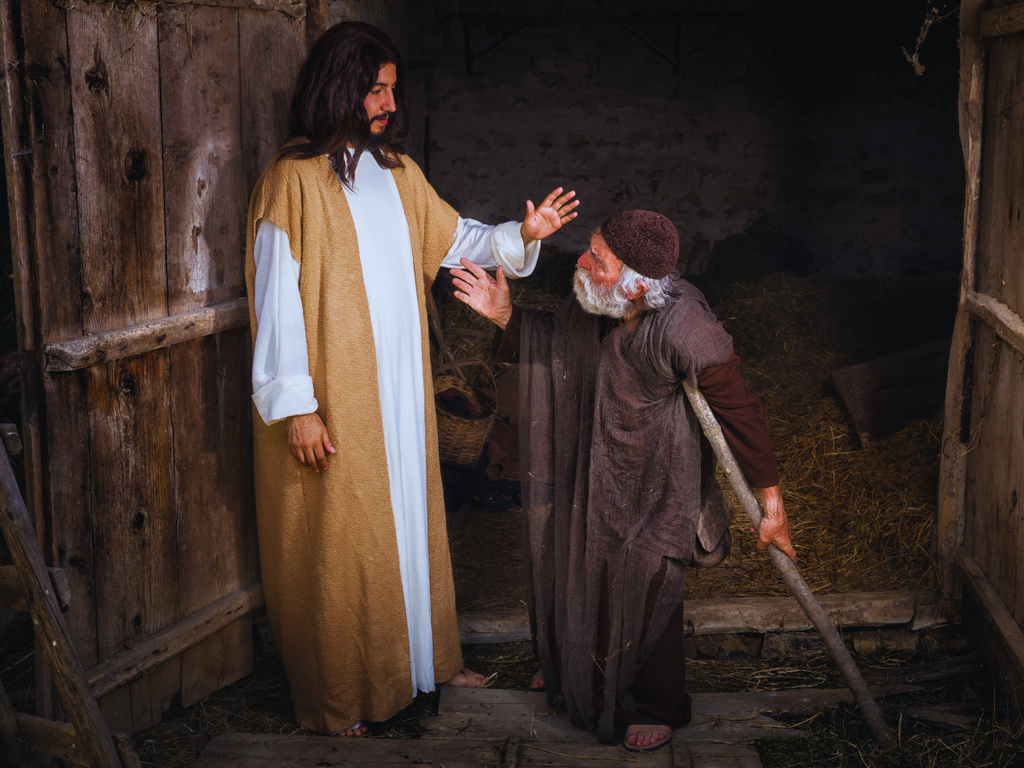
Jesus touched a leper, someone no one touched. Notice the “I will.” The leper had said, “If thou wilt.” Jesus answers the question behind the question.
That it might be fulfilled which was spoken by Esaias the prophet, saying, Himself took our infirmities, and bare our sicknesses.
30. Matthew 8:17 (KJV)
Matthew quotes Isaiah 53:4 after an evening of healings. “Infirmities” is astheneia (weakness) and “sicknesses” is nosos (disease). Jesus takes both.
But Jesus turned him about, and when he saw her, he said, Daughter, be of good comfort; thy faith hath made thee whole. And the woman was made whole from that hour.
31. Matthew 9:22 (KJV)
A woman who had been bleeding for twelve years touched His cloak. He turned and said, “Daughter.” The Greek for “made whole” is sozo, the same word used for being saved. He restored her place among her people (Mark 5:21 to 34).
And Jesus went forth, and saw a great multitude, and was moved with compassion toward them, and he healed their sick.
32. Matthew 14:14 (KJV)
The Greek for “moved with compassion” is splagchnizomai, a gut level word. He had been looking for a quiet place, and when the crowd came, He healed them first.
And he said unto her, Daughter, thy faith hath made thee whole; go in peace, and be whole of thy plague.
33. Mark 5:34 (KJV)
“Go in peace” means shalom. Jesus does not just stop the bleeding. He sends her out whole.
And straightway the father of the child cried out, and said with tears, Lord, I believe; help thou mine unbelief.
34. Mark 9:24 (KJV)
A father says, “Lord, I believe; help thou mine unbelief.” His faith was mixed and honest, and Jesus healed his son. It is a comfort for anyone whose faith feels small.
The Spirit of the Lord is upon me, because he hath anointed me to preach the gospel to the poor; he hath sent me to heal the brokenhearted, to preach deliverance to the captives, and recovering of sight to the blind, to set at liberty them that are bruised.
35. Luke 4:18 (KJV)
Jesus’ mission statement. A note on honesty: some ancient manuscripts leave out “to heal the brokenhearted,” and many modern translations omit it here, though the idea is in Isaiah 61:1.
When Jesus saw him lie, and knew that he had been now a long time in that case, he saith unto him, Wilt thou be made whole?
36. John 5:6 (KJV)
“Wilt thou be made whole?” Jesus asked a man who had been ill for thirty eight years (John 5:1 to 9). The question is not a rebuke. It is an invitation to want what He is offering.
Jesus answered, Neither hath this man sinned, nor his parents: but that the works of God should be made manifest in him.
37. John 9:3 (KJV)
“Neither hath this man sinned, nor his parents.” Jesus rejects the idea that all illness is punishment (John 9). It is one of the most important verses for anyone who has been told they are sick because of sin.
The thief cometh not, but for to steal, and to kill, and to destroy: I am come that they might have life, and that they might have it more abundantly.
38. John 10:10 (KJV)
Jesus came that we might have life “more abundantly.” His purpose is life, set against the thief who steals, kills, and destroys.
Jesus never treated illness as a problem to manage. He treated people as someone to restore.
What are the key healing verses in Acts and the letters?
The healing continues through the apostles, and the letters add honest realism.
Then Peter said, Silver and gold have I none; but such as I have give I thee: In the name of Jesus Christ of Nazareth rise up and walk.
39. Acts 3:6 (KJV)
Peter says, “Silver and gold have I none; but such as I have give I thee.” The healing flows from the name of Jesus, and Peter is quick to say it is not his own power (Acts 3:1 to 16).
How God anointed Jesus of Nazareth with the Holy Ghost and with power: who went about doing good, and healing all that were oppressed of the devil; for God was with him.
40. Acts 10:38 (KJV)
A summary of Jesus’ ministry: He went about doing good and healing. Peter adds, “for God was with him.” Healing is one of the signs that God was present.
But if the Spirit of him that raised up Jesus from the dead dwell in you, he that raised up Christ from the dead shall also quicken your mortal bodies by his Spirit that dwelleth in you.
41. Romans 8:11 (KJV)
The Spirit who raised Jesus lives in believers and will give life to mortal bodies. It is a promise rooted in the resurrection, with hope for the present and the future.
And he said unto me, My grace is sufficient for thee: for my strength is made perfect in weakness. Most gladly therefore will I rather glory in my infirmities, that the power of Christ may rest upon me.
42. 2 Corinthians 12:9 (KJV)
Paul asked three times about his thorn and received grace instead of removal (2 Corinthians 12:7 to 10). It shows that not every prayer for healing is answered with a cure, and that this is no failure of faith.
And the peace of God, which passeth all understanding, shall keep your hearts and minds through Christ Jesus.
43. Philippians 4:7 (KJV)
The Greek for “keep” is a military word for a guard. God’s peace stands guard over the heart and mind. It is healing for the anxious.
Is any sick among you? let him call for the elders of the church; and let them pray over him, anointing him with oil in the name of the Lord.
44. James 5:14 (KJV)
The sick person calls the elders, who pray and anoint with oil. Oil was both medicine and a symbol in the ancient world. It is a community act, not a solo one (James 5:13 to 20).
And the prayer of faith shall save the sick, and the Lord shall raise him up; and if he have committed sins, they shall be forgiven him.
45. James 5:15 (KJV)
“The prayer of faith shall save the sick.” The word “save” is sozo. The verse also mentions forgiveness. It is not a formula, since the same letter shows faithful people who suffered.
Confess your faults one to another, and pray one for another, that ye may be healed. The effectual fervent prayer of a righteous man availeth much.
46. James 5:16 (KJV)
Confess, pray for one another, and be healed. Elijah is the example in the next verse: an ordinary man who prayed earnestly.
Who his own self bare our sins in his own body on the tree, that we, being dead to sins, should live unto righteousness: by whose stripes ye were healed.
47. 1 Peter 2:24 (KJV)
“By whose stripes ye were healed.” Peter quotes Isaiah 53 in the context of sin and righteousness. The verb is in the past tense: the work is already done.
Beloved, I wish above all things that thou mayest prosper and be in health, even as thy soul prospereth.
48. 3 John 1:2 (KJV)
This is a greeting from John to a friend, a wish for his health and for his soul to prosper. It is a good prayer to pray for others, and it puts the soul first. It is not a promise that God makes to every believer.
Jesus Christ the same yesterday, and to day, and for ever.
49. Hebrews 13:8 (KJV)
“Jesus Christ the same yesterday, and to day, and for ever.” It is the ground of our confidence in His character. It does not guarantee that every outcome looks the same.
And God shall wipe away all tears from their eyes; and there shall be no more death, neither sorrow, nor crying, neither shall there be any more pain: for the former things are passed away.
50. Revelation 21:4 (KJV)
The last word. Every tear wiped away, no more death, sorrow, crying, or pain. Every healing in this life is a sign pointing here (Revelation 21:1 to 5).
Frequently Asked Questions
What are the most important Bible verses about healing?
Exodus 15:26, Psalm 103:2 to 3, Isaiah 53:5, Jeremiah 17:14, Matthew 8:17, James 5:14 to 15, and 1 Peter 2:24 are widely seen as central. Together they show that God is the healer, that Jesus carries our weakness, and that the church prays for the sick.
Does Isaiah 53:5 promise physical healing?
The verse says “with his stripes we are healed.” Peter applies it to sin and righteousness in 1 Peter 2:24, and Matthew applies Isaiah 53:4 to Jesus healing the sick. Christians agree the cross is the source of all healing. They differ on whether physical healing is guaranteed now or fully realized at the resurrection.
Is sickness a punishment from God?
Not always. In John 9:3, Jesus says a man born blind was not suffering because of sin. Some Old Testament passages connect affliction to unfaithfulness, but the New Testament warns against assuming it. When someone is sick, we are called to care, not to blame.
Why were some people in the Bible not healed?
Paul asked three times about his thorn and was told, “My grace is sufficient for thee” (2 Corinthians 12:9). Timothy had frequent illnesses (1 Timothy 5:23). Lazarus was raised and later died again. These stories do not say anyone lacked faith. They say that God’s care is larger than a single outcome.
Which Bible verse is best to pray for a sick person?
Many people pray Jeremiah 17:14, Psalm 107:20, James 5:14 to 15, or Psalm 147:3. Say the person’s name, read the verse, and tell Jesus what you see. You do not need perfect words.
Sit With This Today
Which of the fifty verses felt like it was written for you?
Which verse did you misunderstand before reading the note?
Who could you read one of these verses to this week?
A Closing Prayer
PRAYER
Lord Jesus, You are the healer of my body, my mind, and my soul. You touched the leper, You called the woman daughter, and You asked the man by the pool if he wanted to be well. Ask me too. Heal what You choose to heal, and hold me in the waiting. Give wisdom to the doctors, comfort to the grieving, and peace to everyone I love who is hurting. You took our weakness and carried our sickness, and You rose again. I trust You. Amen.
Continue Reading on Restored in Prayer
More at Restored in Prayer: 200+ Powerful Bible Verses About Healing, 100 Healing Scriptures in the Bible, Healing Scriptures for the Sick, 50+ Healing Scriptures to Declare, and 80+ Healing Bible Verses.