There is a particular kind of loneliness that only married people know. It is not the loneliness of an empty house or a quiet Friday night. It is the loneliness of lying beside someone you once knew with complete certainty, now feeling the width of an ocean between you, wondering how you got here and whether anything can change. If you are in that place right now, this article is written for you.
Christian marriage help is not about applying a set of techniques to a struggling relationship. It is about returning to the original architect of marriage and allowing him to rebuild what sin, selfishness, and time have worn down. Because the same God who said at the beginning “it is not good for man to be alone” is still in the business of making two into one. He has not given up on your marriage even when you are close to it.
This article walks through the biblical foundation of marriage, the most common causes of struggle and distance, and the practical, God-centered steps that genuinely transform a home. Furthermore, it is written for the couple who is fighting, the couple who has grown silent, and the couple who loves each other but feels completely lost.
What God Actually Designed Marriage to Be
Before you can fix something, you have to understand what it was originally built to do. Therefore, any honest search for Christian marriage help has to begin not with your problems but with God’s design.
Genesis 2 is the first wedding in human history, and God himself is the one who performs it. He takes the woman to the man, the man responds with a poetry of recognition and wonder, “This at last is bone of my bones and flesh of my flesh,” and then the narrator steps in with a statement that every married couple needs to carry: “Therefore a man shall leave his father and his mother and hold fast to his wife, and they shall become one flesh” (Genesis 2:24). Three movements. Leaving. Cleaving. Becoming one.
The leaving is a severing of former primary allegiances. The cleaving is a commitment so fierce and so sustained that it reshapes everything. The becoming one is not merely physical but spiritual, emotional, and relational. Two separate lives genuinely joined into something that is more than the sum of its parts.
However, the most startling thing about marriage in Scripture is what Paul reveals in Ephesians 5. He quotes Genesis 2:24 and then says, “This mystery is profound, and I am saying that it refers to Christ and the church” (Ephesians 5:32). Your marriage is not just a domestic arrangement or a legal partnership. It is a living parable. It is designed to show the watching world something of the relationship between Jesus and the people he loves. The husband’s self-giving love is meant to mirror Christ’s love for the church. The wife’s trust and responsiveness is meant to reflect the church’s relationship with its Lord.
This is why the enemy works so hard to destroy marriages. He is not primarily interested in causing domestic unhappiness. He is interested in defacing the image. A broken marriage is a broken picture of the Gospel. Consequently, fighting for your marriage is not just a personal matter. It is a spiritual one.
For a rich biblical exploration of what marriage was designed to display, Desiring God’s full resource library on marriage is one of the finest collections available online, rooted in Scripture and written with pastoral depth.
Why Christian Marriages Struggle: Naming the Real Problem
One of the most important pieces of Christian marriage help is an honest diagnosis. Many couples spend years treating symptoms without identifying the underlying cause, and therefore the same patterns keep returning no matter how many conversations or counseling sessions they have.
The Problem of Self at the Center
Every marriage struggle, at its root, traces back to the same source: two sinners living at close range, each one naturally inclined to put themselves first. Paul names it plainly in Ephesians 5 when he describes what Christian marriage looks like, and the description is entirely organized around dying to self. Husbands are called to love as Christ loved the church, and Christ loved the church by giving himself up for her. Wives are called to submit as the church submits to Christ, and the church’s submission is not the posture of the defeated but of the loved and responsive.
Neither of these postures comes naturally to sinful human beings. As Desiring God notes in their article on marriage, a marriage built on self-fulfillment is structurally fragile from the start, because it rests on what the other person can give rather than on the covenant both persons made before God.
The moment you married, you inherited a project: the slow, lifelong work of dying to yourself in the specific context of this particular person. That is not romantic language. It is the language of the cross. And it is the only thing that produces the kind of love that endures through every season.
The Problem of Unaddressed Sin and Unforgiveness
Furthermore, one of the most common roots of emotional distance in a marriage is unresolved hurt that has hardened into bitterness. Something was said or done months or years ago. It was never fully addressed. It was never fully forgiven. And slowly, without either person quite realizing it, a wall was built, one small stone at a time.
Hebrews 12:15 warns about “a root of bitterness” that springs up and “causes trouble, and through it many become defiled.” The root is almost always invisible while the damage is becoming irreversible. Consequently, if you sense that your emotional distance from your spouse has a history to it, a specific wound or pattern of wounds that was never healed, that is the place to begin. Not to relitigate the past but to bring it honestly before God and before your spouse and let forgiveness do the work only it can do.
Colossians 3:13 is one of the most practical verses in the New Testament for struggling marriages: “Bear with each other and forgive one another if any of you has a grievance against someone. Forgive as the Lord forgave you.” The standard is not “forgive when you feel like it” or “forgive when they deserve it.” The standard is the forgiveness you yourself received from God when you deserved none of it.
The Problem of Prayerlessness
Many couples who claim to be Christian marriages have, in practice, built their home without much reference to God. They attend church on Sundays. They may read their Bibles individually. However, they do not pray together. They do not seek God together. They do not bring their marriage itself to God in prayer with any consistency.
The result is a marriage that is Christian in name but largely secular in practice, a marriage operating on human resources alone when divine ones are available. First Peter 3:7 describes a husband’s prayer being “hindered” by the way he treats his wife, which implies the reverse: a marriage lived in mutual honor and prayer is one whose communication with heaven is flowing. A praying marriage is a different kind of marriage. Not a perfect one. A living one.
Christian Marriage Help When You Are Fighting
Conflict in marriage is not a sign that you married the wrong person. It is a sign that two sinners have agreed to live in close proximity for the rest of their lives. What matters is not whether you fight but how, and what you do with the aftermath.
Learn to Fight Toward Each Other, Not Against Each Other
Ephesians 4:26 gives a command that sounds almost impossible in the middle of a heated argument: “Be angry and do not sin; do not let the sun go down on your anger.” Paul does not say do not be angry. He says do not let anger do what anger wants to do, which is damage, wound, and build walls.
The most transformative shift in marital conflict is the recognition that your spouse is not your enemy. The enemy is the enemy. Your spouse is your partner in a covenant that the enemy is actively trying to destroy. Therefore, when conflict rises, the question to ask is not “how do I win this argument” but “how do we get through this together.”
James 1:19 gives one of the most practical instructions in Scripture: “Everyone should be quick to listen, slow to speak and slow to become angry.” In conflict, most people reverse this entirely. They are slow to listen, quick to speak, and even quicker to anger. Reversing that order is a discipline that has to be practiced, consciously and repeatedly, until it becomes instinct.
Address Patterns, Not Just Incidents
Additionally, most marital fights are not really about what they appear to be about on the surface. The argument about the unwashed dishes is usually an argument about feeling unseen. The fight about money is usually an argument about security and control. The repeated conflict about how one of you spends time is usually an argument about whether you feel like a priority.
Therefore, genuinely helpful conflict resolution in a Christian marriage requires the willingness to ask not just “what are we fighting about” but “what does this fight reveal about what each of us actually needs.” That kind of conversation is much harder. Nevertheless, it is the one that actually moves things forward.
If conflict has become so severe and so entrenched that you cannot have a productive conversation without it escalating, that is a clear sign that outside help is needed. GotQuestions has a thorough guide on when and why Christian couples should seek marriage counseling that is worth reading honestly and without defensiveness.
Christian Marriage Help When You Have Grown Distant

Distance in marriage is in some ways harder to address than open conflict, because at least conflict has heat and energy. Distance has neither. It is the slow cooling of a fire that was once warm, the gradual substitution of politeness for intimacy, the moment when you realize you have been sharing a house with a stranger.
Identify When the Drift Began
The first step in recovering from emotional distance is the honest work of tracing it. There was a point when things began to change. Perhaps it was the arrival of children and the exhaustion that came with them. Perhaps it was a season of intense work pressure that required emotional resources the marriage was not getting. Perhaps it was an unaddressed conflict that neither of you felt equipped to resolve. Perhaps it was simply the slow accumulation of years without intentional investment in each other.
Similarly to how a physical wound left untreated does not simply stay the same but gets worse, emotional distance left unaddressed does not stabilize. It deepens. Consequently, the time to address it is not when it becomes a crisis but the moment you notice it beginning.
Rebuild Intentionally
Emotional intimacy in a marriage does not return by itself. It has to be intentionally rebuilt, in the same way that physical fitness has to be rebuilt after a long period of inactivity. The muscles are still there. The capacity is still there. However, it requires consistent, deliberate effort before the results become visible.
Here are the most reliable places to begin:
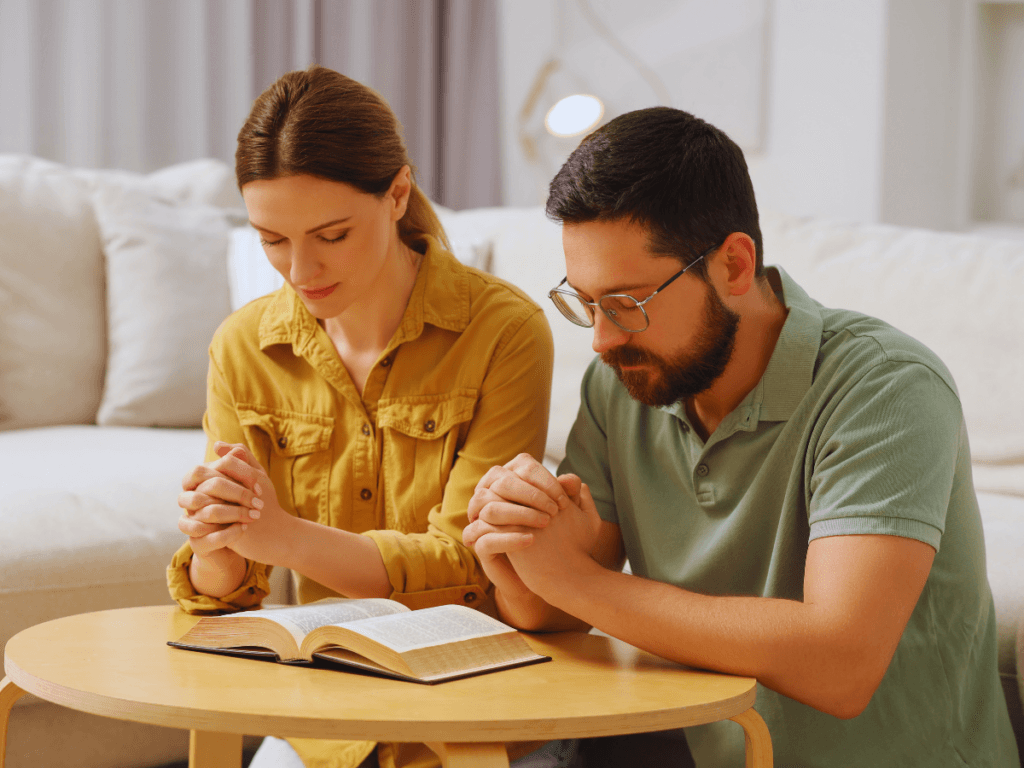
Begin praying together out loud, even briefly, even awkwardly. There is something about praying together that cuts through walls that conversation alone cannot penetrate. When you stand before God together, the pretenses tend to fall away. Many couples who have experienced significant emotional restoration trace its beginning to the simple, vulnerable act of praying together for the first time in years.
Begin pursuing curiosity about your spouse again. Ask questions about what they are thinking about, what they are worried about, what they are hoping for. Not the logistical questions of a shared household but the genuine relational questions of a person who wants to know another person. Most couples in distress have stopped being curious about each other. Curiosity, rekindled and sustained, is one of the most powerful tools of reconnection available to a married couple.
Begin serving each other with small, specific intentionality. Not grand gestures but the daily attentiveness that says “I notice you” and “I am thinking about you.” Galatians 5:13 describes the Christian life as using freedom “to serve one another humbly in love.” That principle has its most immediate and most consequential application inside a marriage.
For practical, biblically grounded guidance on restoring a marriage that has grown cold, GotQuestions offers a direct and honest article on restoring your marriage that many couples have found helpful as a starting point.
The Role of Prayer in a God-Centered Home
No discussion of Christian marriage help is complete without an extended treatment of prayer, because prayer is not merely one tool among many. It is the atmosphere in which a God-centered marriage breathes.
Philippians 4:6 says to “not be anxious about anything, but in every situation, by prayer and petition, with thanksgiving, present your requests to God.” The word “every” is doing significant work in that verse. Every situation includes the marriage. Every situation includes the fight you had last night and the silence that has lasted three weeks and the fear that maybe things will never change.
When two people bring their marriage consistently and specifically to God in prayer, several things happen over time. First, they are repeatedly reminded that their marriage is not theirs alone to manage. It belongs to the God who designed it and who is actively invested in its flourishing. Second, they create a shared language of dependency and vulnerability that transfers to how they relate to each other. A couple that prays together regularly is, by definition, a couple that has learned to be honest together before God. Third, prayer releases the power of the Holy Spirit into the specific circumstances of the marriage in ways that human effort alone cannot produce.
Matthew 18:19 contains a promise that applies to marriage as clearly as it applies to any other context: “If two of you agree on earth about anything they ask, it will be done for them by my Father in heaven.” Two people in covenant, agreeing in prayer, have access to the throne of heaven. That is not a small thing. It is the most significant resource available to a struggling marriage.
Our guide on building a daily prayer life walks through the rhythms and practices that make prayer sustainable and transformative for individuals and couples alike.
Building a God-Centered Home: Practical Foundations
Christian marriage help ultimately points toward a destination: a home that is genuinely organized around God, not merely decorated with religious language. Here is what that looks like in practice.
Make Christ the Actual Center, Not the Decorative Frame
Many Christian homes have Christianity as decor. A verse on the wall. A Bible on the shelf. Grace before meals on special occasions. However, the God-centered home that Scripture describes is one where the living God is the actual organizing principle of daily life, the one whose purposes shape decisions about money, time, conflict, parenting, and everything else.
Deuteronomy 6:6 and 7 describes this kind of home: “These commandments that I give you today are to be on your hearts. Impress them on your children. Talk about them when you sit at home and when you walk along the road, when you lie down and when you get up.” The Word of God was meant to saturate the home, not merely visit it on Sundays.
Practically, this means reading Scripture together. It means discussing what God is doing in each of your lives. It means making decisions together by asking not “what do we want” but “what does God seem to be directing.” It means bringing the Word into conflict, into parenting, into finances, rather than compartmentalizing faith as a Sunday activity.
Serve Each Other as an Act of Worship
One of the most overlooked realities in Christian marriage is that how you treat your spouse is an act of worship or an act of desecration. You cannot separate the way you treat the person made in God’s image and the way you treat God himself. First John 4:20 makes this uncomfortably clear: “Whoever claims to love God yet hates a brother or sister is a liar.”
Therefore, choosing patience with your spouse when impatience feels justified is an act of worship. Choosing to listen when you would rather be heard is an act of worship. Choosing gentleness in the middle of conflict when your flesh wants to win the argument is an act of worship. As GotQuestions describes in their article on what makes a Christian marriage genuinely different, the distinguishing mark of a Christian marriage is not the absence of struggle but the presence of Christ transforming both people through the struggle.
Cultivate Gratitude for What You Have
Furthermore, one of the most corrosive forces in a struggling marriage is the habit of focusing on what your spouse lacks rather than what they bring. Every human being has a natural tendency to notice what is missing more readily than what is present. In a marriage, that tendency, left unchecked, produces a growing list of grievances and a shrinking capacity for genuine appreciation.
Philippians 4:8 offers a deliberate counter-practice: “Whatever is true, whatever is noble, whatever is right, whatever is pure, whatever is lovely, whatever is admirable, think about such things.” Applied to a marriage, this is an instruction to cultivate a practice of noticing and naming what is good in your spouse. Not to deny what is genuinely difficult but to refuse to let the difficult crowd out the good.
Many couples who have experienced genuine renewal in a struggling marriage describe a shift in this direction as one of the early markers of change. Not a sudden dramatic transformation but a deliberate daily choice to begin seeing their spouse through the lens of what God is doing in them rather than through the lens of what still needs to change.
Seek Help Without Shame
Additionally, one of the most important pieces of practical Christian marriage help is the removal of the shame that keeps many couples from asking for help until the marriage is in acute crisis. Proverbs 11:14 says plainly that “in an abundance of counselors there is safety.” Seeking the counsel of a pastor, a mature married couple, or a biblical marriage counselor is not an admission of failure. It is an act of wisdom.
The couples who do best in marriage over the long run are almost never the ones who figured everything out on their own. They are the ones who stayed humble enough to keep learning, to keep asking for help, and to keep submitting their marriage to the wisdom of the wider body of Christ.
GotQuestions provides an excellent guide on making a marriage last that addresses the practical and spiritual commitments that sustain a marriage through every season, and is worth returning to regularly throughout the life of a marriage.
When Things Feel Hopeless: A Word for the Exhausted
There is a specific kind of exhaustion that sets in when you have tried everything you know to try, when you have had the same conversation for the hundredth time, when the same pattern has cycled through again and you genuinely do not know if anything can change.
This article would be incomplete without addressing that person directly.
The God of Scripture is specifically and repeatedly described as the one who does what is impossible for human beings. He opened a way through the Red Sea when there was no way. He brought dry bones to life in the valley of Ezekiel’s vision. He raised Jesus from the dead when every door had been sealed and every hope had been buried.
None of those outcomes were produced by human effort or optimism. They were produced by the power of a God who is not limited by the evidence in front of you. Joel 2:25 contains one of the most breathtaking promises in Scripture for the person in a season of loss: “I will restore to you the years that the swarming locust has eaten.” The lost years. The wasted years. The years of distance and silence and pain. He can restore them.
This does not mean every marriage will be restored in the form you are hoping for. The New Testament does allow for certain circumstances in which separation or divorce becomes necessary for protection or because of abandonment. However, it does mean that no marriage is beyond the reach of a God who specializes in resurrection. No distance is too great. No pattern is too entrenched. No heart is too hard. None of that is a statement about what you are capable of. It is a statement about what he is capable of.
Our article on finding hope through prayer in difficult seasons speaks directly to the experience of waiting for God to move in a situation that feels stuck.
A Reflective Moment
Before you continue, pause with these questions. Let them sit quietly rather than rushing past them.
When did you last tell your spouse specifically what you appreciate about them? When did you last pray together out loud? When did you last ask your spouse how they were really doing and stay long enough to hear the honest answer? When did you last bring your marriage specifically and honestly to God in prayer, not a general prayer for the family, but a prayer that named the actual state of things and asked for his specific help?
These are not questions of condemnation. They are invitations. The path back to each other almost always begins with a small, honest step in the right direction.
Frequently Asked Questions About Christian Marriage Help
Is it normal for Christian marriages to struggle this much? Yes. Every marriage between two human beings will face significant struggle because every human being is sinful and incomplete. The presence of struggle in your marriage does not mean you failed or that God is absent. It means you are human. What matters is whether you bring the struggle to God and to each other honestly, and whether you keep choosing the covenant you made even when it costs you.
What does the Bible say about a husband and wife who cannot stop fighting? Scripture consistently calls both husbands and wives to pursue peace, to be quick to listen and slow to anger, and to address conflict in love rather than in contempt. Ephesians 4:29 gives a practical standard: “Let no corrupting talk come out of your mouths, but only such as is good for building up.” If your conflicts have become consistently destructive, that is a clear signal to seek outside pastoral or counseling support rather than continuing to cycle through the same patterns alone.
How do we rebuild emotional intimacy after years of distance? Slowly and intentionally, starting with the smallest honest steps. Begin praying together. Begin asking genuine questions. Begin expressing appreciation specifically and consistently. Emotional intimacy is rebuilt the same way it was originally built, through repeated small investments of attention, vulnerability, and care. It took time to grow cold and it will take time to warm again. Nevertheless, it does warm for couples who are willing to keep showing up.
Should Christian couples always avoid divorce? Scripture takes the covenant of marriage with the utmost seriousness, and God is described in Malachi 2:16 as hating divorce for the damage it does to everyone involved. However, the New Testament does recognize certain circumstances, including sexual unfaithfulness and abandonment by an unbelieving spouse, in which divorce may be permitted. Even in those circumstances, the posture of the Christian is one of grief rather than relief, and the goal when at all possible is reconciliation and restoration.
How do we make God the center of our marriage practically? Begin with daily Bible reading and prayer together, even briefly. Bring financial, parenting, and major life decisions to God in prayer together before discussing them between yourselves. Choose a church community where both of you are known and invested, not just attending. Find one or two other married couples further along in faith whose marriage you want to emulate, and pursue relationship with them intentionally.
What if only one of us wants to work on the marriage? This is one of the most painful realities a married person can face. First Peter 3:1 speaks directly to this situation, encouraging a believing spouse to live in such a way that a resistant partner might be won “without a word” by the quality of your conduct. You cannot control your spouse. However, you can control your own faithfulness to the covenant, your own posture of prayer, and your own willingness to keep showing up in love. Additionally, seek pastoral support and counsel so that you are not carrying this alone.
When is it time to seek professional marriage counseling? Proverbs 11:14 suggests that seeking counsel is wisdom rather than weakness. If the same conflicts keep returning without resolution, if emotional distance has persisted for months, if either person feels unsafe or consistently unheard, if communication has effectively broken down, these are all clear signs that the wisdom of a trained biblical marriage counselor is warranted. Seeking help early is always better than waiting until the marriage is in acute crisis.
Conclusion: The God Who Restores
The opening question of this article was whether anything can change. The answer Scripture gives is not a vague hope but a specific promise, grounded in the character of a God who has been restoring broken things since the beginning.
He restored Peter after the denials. He restored the prodigal after the far country. He restored Ruth after the grief. He restored Hosea’s marriage after the betrayal, and he used that restored marriage as the central metaphor of his own love for his people.
Therefore, whatever state your marriage is in right now, it is not outside the reach of what he does. The struggling marriage, the silent marriage, the fighting marriage, each one is a place where the grace of God can do what human effort cannot.
Return to the beginning. Return to the covenant. Return to the God who designed this institution and who holds every marriage in his hands. Bring him the honest state of things, without a performance of faith you do not feel, without the polished version of your marriage that you present to others. Just the truth. Just you and your spouse and the God who made you both and who loves you both with a love that does not give up.
He is not finished with your marriage. He is not finished with you.
Father, we bring you this marriage honestly, in all its beauty and all its brokenness. We have tried to build it on our own resources and we have felt those resources fail. We confess our selfishness, our pride, our unforgiveness, and the ways we have failed each other and failed you. We ask you now to do what only you can do. Restore what has been lost. Soften what has grown hard. Rebuild what has been damaged. Make us the kind of husband and wife that images your love for your people. Give us patience with each other, grace for each other, and the stubborn faith to keep choosing each other even when it is hard. We trust you with what we cannot fix ourselves. In Jesus name, amen.