The Holy Rosary: Meaning, Prayers, and Mysteries.
There is a particular kind of quiet that settles over a room when someone is praying the Rosary. The pace slows. The world, for twenty minutes or so, gets smaller and gentler. Beads pass through fingers one at a time, and words that have been prayed for centuries rise again, a little worn and a little new, in a voice that belongs to this moment. If you have ever wondered why this simple string of beads has held such a steady place in Catholic life for hundreds of years, you are asking a good question, and it is one worth taking slowly.
This is an exploration of the Rosary from the ground up: where it came from, what each prayer means, how the beads are used, and what the mysteries are asking us to see. Whether you are holding a rosary for the first time or you have prayed one every day since childhood, I hope something here helps the prayer feel less like a routine and more like what it truly is, a walk through the life of Christ with his mother at your side.

What Does the Word Rosary Mean
The word rosary comes from the Latin rosarium, meaning a garland or crown of roses. In medieval Europe, offering roses to someone of honor was a sign of love and respect, and praying the Hail Mary was understood as offering a spiritual rose to the Blessed Mother. Fifty Hail Marys became, in the popular imagination, fifty roses woven into a crown laid at Mary’s feet. It is a lovely image, and it says something important about the whole prayer. The Rosary was never meant to be mechanical. It was meant to be a gift, offered slowly and with love, one bead and one rose at a time.
Where the Rosary Came From
The full history of the Rosary is layered and a little mysterious, woven together from centuries of Christian devotion rather than invented in a single moment. Praying with knotted cords or strings of beads to count repeated prayers goes back to the earliest centuries of Christian monasticism, when monks would recite long strings of Our Fathers, sometimes called a paternoster, using knotted ropes to keep count, as the history of the Rosary on Wikipedia traces in detail.
The most beloved account of the Rosary’s origin centers on Saint Dominic, founder of the Dominican Order, in the early thirteenth century. According to a long standing tradition, the Blessed Virgin Mary appeared to Dominic while he was preaching against the Albigensian heresy in southern France and gave him the Rosary as a weapon of prayer, promising that meditating on the life of her Son would soften hardened hearts. Franciscan Media’s account of this tradition notes that Mary told Dominic to teach the devotion to others and assured him his preaching would bear great fruit because of it.
Historians are honest that the documentary evidence for this precise story is thin. As EWTN’s history of the Rosary explains, the earliest biographies of Saint Dominic do not mention the Rosary, and some scholars argue the devotion developed gradually rather than arriving all at once through a single vision. What does seem clear is that a Carthusian monk named Dominic of Prussia, writing in the fifteenth century, played a major role in shaping the Rosary as we recognize it today, attaching short meditations on the life of Christ to each Hail Mary, a structure that eventually settled into the Joyful, Sorrowful, and Glorious mysteries. U.S. Catholic magazine traces this development well, showing how the Rosary as we know it took its recognizable form by the sixteenth century, even as the practice of praying with beads reaches back much further still.
Whatever the precise historical path, the Church has long treasured the connection between the Rosary and Saint Dominic, and popes for centuries have credited him with popularizing it, especially through the Dominican Order’s tireless preaching of the devotion across Europe. It remains one of the most enduring and cherished prayers in the whole of Catholic life, exactly as the Rosary Center and Confraternity describes it.
The Rosary Beads Themselves
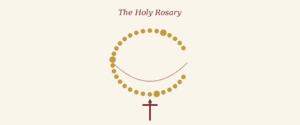
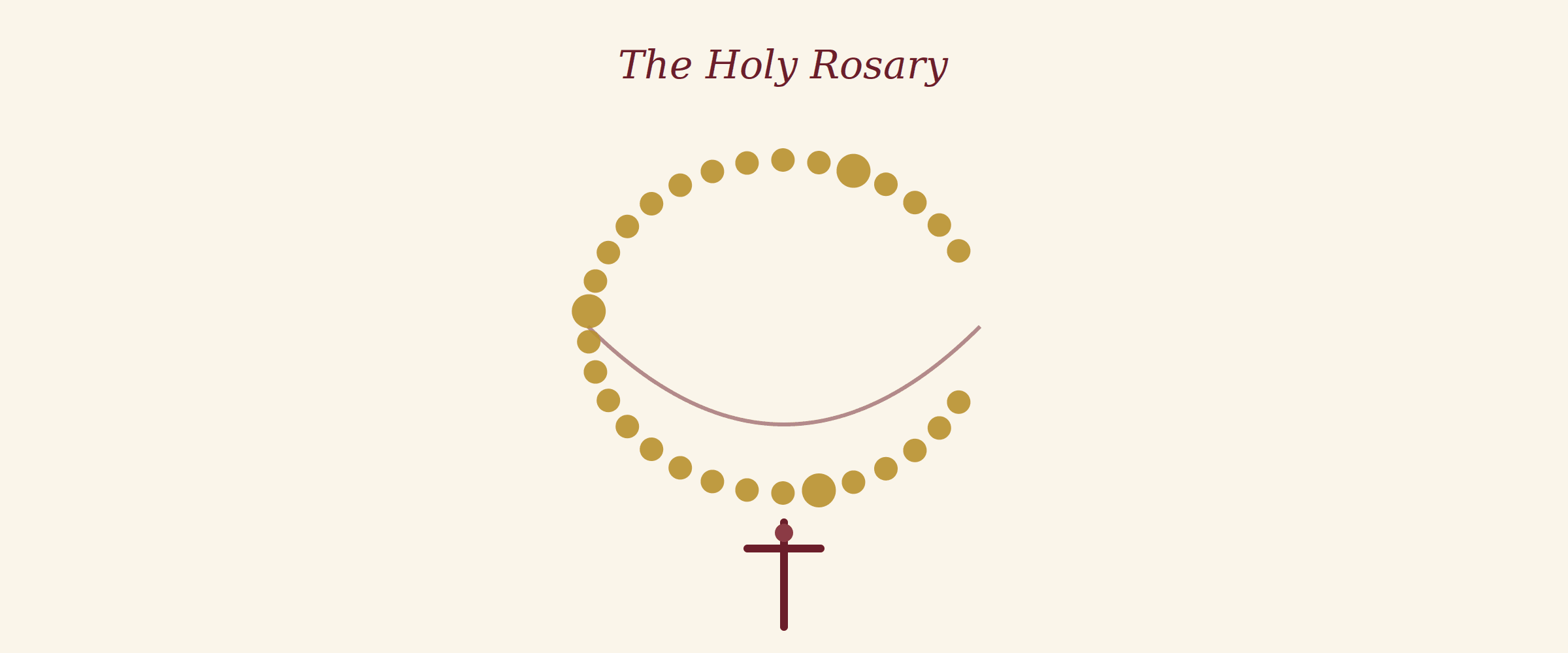
A standard five decade rosary has a crucifix at one end, followed by one large bead, then three small beads, then another large bead, which leads into a small medal or the meeting point of a loop. From there the loop unwinds into five sets, or decades, each made of one large bead followed by ten small beads. Large beads mark the Our Father. Small beads mark the Hail Mary. It is a simple design, but every part of it has a purpose, guiding your hands so your mind is free to pray rather than count.
How to Pray the Rosary, Step by Step
If you are new to this prayer, here is the traditional order. Take it slowly. There is no prize for finishing quickly, and the whole point of the beads is to let your mind rest in the words rather than race through them.
- Begin with the Sign of the Cross, holding the crucifix.
- Pray the Apostles Creed on the crucifix, professing the core beliefs of the faith.
- Pray one Our Father on the first large bead.
- Pray three Hail Marys on the next three small beads, traditionally for an increase of faith, hope, and love.
- Pray the Glory Be, giving praise to the Trinity.
- Announce the first mystery, then pray one Our Father on the large bead.
- Pray ten Hail Marys on the small beads of that decade while meditating on the announced mystery.
- Close the decade with the Glory Be, and many people also add the Fatima Prayer here, asking the Lord to lead all souls to heaven and to have mercy on those most in need.
- Repeat this pattern for all five mysteries.
- Close with the Hail, Holy Queen, sometimes followed by a closing prayer, and finish with the Sign of the Cross.
The exact words of these prayers, along with several traditional variations, are laid out clearly by the United States Conference of Catholic Bishops’ guide to praying the Rosary, which is a wonderful page to keep bookmarked, especially in the early weeks of learning the prayer.
| If counting decades still feels unfamiliar, do not worry. Most people who pray the Rosary daily still occasionally lose track of which bead they are on. That is completely fine. The goal was never precision. It was presence. |
The Mysteries of the Rosary
The heart of the Rosary is not really the repetition of words. It is meditation. While the lips move through the Our Father and Hail Mary, the mind is meant to walk through a scene from the life of Jesus and Mary, entering it the way you might enter a familiar story you have heard a hundred times and still find something new inside. These scenes are called the mysteries, and there are twenty in total, grouped into four sets of five.
Traditionally, different mysteries are prayed on different days of the week, though many people simply pray whichever set fits the season or their own heart on a given day.
| Day | Mysteries Prayed |
|---|---|
| Monday and Saturday | Joyful Mysteries |
| Tuesday and Friday | Sorrowful Mysteries |
| Wednesday and Sunday | Glorious Mysteries |
| Thursday | Luminous Mysteries |
 | The Joyful Mysteries These five scenes carry us through the beginning of Christ’s earthly life, from the angel’s greeting to Mary in Nazareth to the young Jesus found teaching in the Temple. They are the Annunciation, the Visitation, the Nativity, the Presentation in the Temple, and the Finding of Jesus in the Temple. Prayed together, they trace the quiet unfolding of God entering the world through the ordinary rhythms of a small, faithful family, and they are especially fitting during Advent and the Christmas season. |
 | The Sorrowful Mysteries These meditations move through the final hours of Christ’s suffering, from his agony in the garden of Gethsemane through his scourging, his crowning with thorns, his carrying of the cross, and his crucifixion. They are the Agony in the Garden, the Scourging at the Pillar, the Crowning with Thorns, the Carrying of the Cross, and the Crucifixion. They are traditionally prayed on Fridays and throughout Lent, drawing the one praying into the weight and the love behind Christ’s Passion. |
 | The Glorious Mysteries These five scenes turn from suffering to triumph. They are the Resurrection, the Ascension, the Descent of the Holy Spirit at Pentecost, the Assumption of Mary into heaven, and the Coronation of Mary as Queen of Heaven and Earth. They carry the prayer forward into hope, celebrating what the Church believes awaits every soul who remains faithful to Christ. |
 | The Luminous Mysteries These are the newest addition to the Rosary, given to the Church by Pope Saint John Paul II. On October 16, 2002, in his apostolic letter Rosarium Virginis Mariae, he proposed five new mysteries drawn from Christ’s public ministry, filling what he saw as a gap between the hidden years of Nazareth and the sorrow of the Passion. They are the Baptism of Jesus in the Jordan, the Wedding at Cana, the Proclamation of the Kingdom of God, the Transfiguration, and the Institution of the Eucharist at the Last Supper. In his letter, John Paul II wrote that Christ is the light of the world, and that each of these mysteries reveals the Kingdom of God present in the very person of Jesus. He asked the faithful to pray them on Thursdays. |

Why the Rosary Is Called a Compendium of the Gospel
Pope Saint John Paul II described the Rosary as a compendium of the Gospel, a phrase he borrowed and expanded from earlier popes who loved this prayer deeply. In Rosarium Virginis Mariae, he wrote that although the Rosary is Marian in character, at its heart it is a Christocentric prayer, because in the calm repetition of the Hail Mary, the entire life of Christ passes before the eyes of the soul. Mary is not the destination of the Rosary. She is the companion who walks the whole path with you, pointing always toward her Son, echoing the words she spoke at the wedding at Cana, whatever he tells you, do it.
To recite the Rosary is nothing other than to contemplate with Mary the face of Christ.
That single sentence, drawn from John Paul II’s letter, captures something easy to miss about this prayer. It is not primarily about finishing fifty Hail Marys. It is about seeing. You can read the full text of Rosarium Virginis Mariae on the Vatican website if you want to sit with the Pope’s own words at greater length. It remains one of the most beautiful pieces of writing on the Rosary the Church has ever produced.
Why Catholics Return to This Prayer Again and Again
Ask ten people who pray the Rosary daily why they keep coming back to it, and you will likely hear ten slightly different answers, but a few themes tend to repeat. Some find in the repetition a kind of stillness that other forms of prayer do not offer them, a rhythm that quiets an anxious mind the way rocking quiets a child. Others turn to the Rosary specifically in seasons of suffering, finding comfort in walking through the Sorrowful Mysteries alongside a Mother who also watched someone she loved suffer. Many families pray it together in the evening, a small daily gathering that asks nothing more than twenty unhurried minutes and a willingness to sit close to one another.
There is also, for many Catholics, a simple sense of trust passed down across centuries of saints who loved this prayer before them. Padre Pio was rarely seen without a rosary in hand. Pope Saint John Paul II called it his favorite prayer. Countless ordinary believers, largely unknown to history, have leaned on these same fifty three beads through war, illness, grief, and long ordinary Tuesdays. There is a quiet comfort in praying words that have been prayed by so many others before you.
A Few Gentle Tips for Beginners
- Do not worry about praying it perfectly. Distraction is normal. Simply notice when your mind has wandered and return gently to the mystery, without frustration.
- Start small if the full five decades feels like too much. Even one decade, prayed slowly and attentively, is a real and complete prayer.
- Try praying it while walking. Many people find that movement helps focus the mind, especially outdoors.
- Keep a rosary somewhere visible, in a car, on a nightstand, in a coat pocket. A physical reminder often does more than good intentions alone.
- If a particular mystery feels dry or difficult one day, stay with it anyway. Some of the deepest fruit of this prayer comes from returning to the same scenes again and again over a lifetime.
Closing Thoughts
The Rosary has survived plagues, wars, the rise and fall of empires, and centuries of changing devotional fashions, and it has done so not because it is complicated or clever, but because it is simple enough to hold in tired hands and deep enough to occupy a lifetime of prayer. It asks very little of you at the start, only a few minutes and a willingness to slow down, and it offers, in return, a steady companion through every season of belief and doubt, joy and sorrow.
If this is new territory for you, consider praying just one decade tonight. Hold the beads. Say the words slowly. Let Mary walk you toward her Son, one small rose at a time.
For more reflections, prayer guides, and resources to help deepen your own prayer life, visit Restored in Prayer, where you will find more writing dedicated to helping you grow closer to Christ through the daily practice of prayer.
Ave Maria.